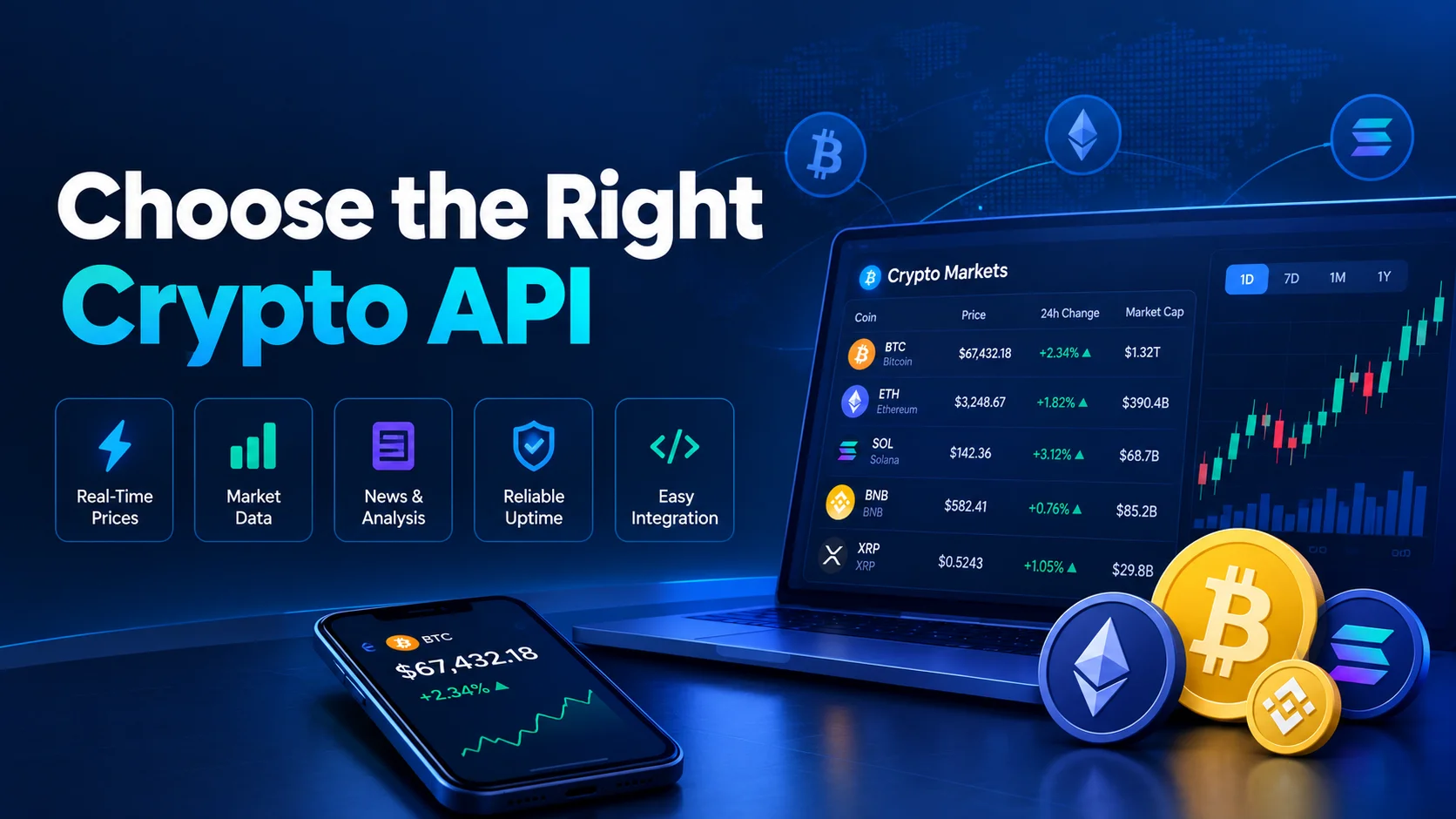


Choosing the right crypto API is an important decision for developers building applications that depend on cryptocurrency market data. Whether you are creating a trading dashboard, portfolio tracker, financial website, mobile application, analytics platform, or automated system, the quality of your API can directly affect how useful and reliable your application becomes.
A crypto API provides access to cryptocurrency information through programmable endpoints. Instead of manually collecting prices and market information from different websites, developers can connect their applications to an API and retrieve structured data automatically. Depending on the provider, this data can include cryptocurrency prices, market statistics, historical information, exchange rates, charts, and other financial information.
But which crypto API is best for developers? The answer depends on what you are building, the type of data you need, how frequently you need updates, and how easily the API can be integrated into your project. Developers should look beyond the number of cryptocurrencies supported and consider factors such as documentation, response format, reliability, scalability, authentication, pricing, and ease of integration.
What Is a Crypto API?
A crypto API is a software interface that allows applications to communicate with a cryptocurrency data provider. Through API requests, a developer can request specific financial information and receive the result in a structured format, commonly JSON.
For example, a cryptocurrency application may need the current Bitcoin price. Instead of storing the price manually, the application can send a request to a crypto market data API. The API processes the request and returns the latest available information.
This approach makes applications more dynamic because market information can be retrieved automatically. Developers can use the returned data to display prices, create charts, calculate market movements, or build other cryptocurrency-related features.
Crypto APIs can be useful for both small projects and large financial applications. A developer experimenting with a cryptocurrency dashboard may only need a few endpoints, while a larger financial platform may require real-time prices, historical data, multiple assets, and additional market information.
What Should Developers Look for in a Crypto API?
The best crypto API for developers is usually one that combines useful data with a simple development experience. Even an API with extensive market coverage can become difficult to work with if its documentation is confusing or its responses are inconsistent.
Documentation should be one of the first things developers examine. Good documentation explains available endpoints, parameters, authentication methods, response formats, errors, and usage examples. Clear documentation reduces the time developers spend trying to understand how an API works.
Another important factor is data coverage. Developers may need information about Bitcoin and other major cryptocurrencies, but applications can eventually require a much broader range of assets. An API that supports a large cryptocurrency market can provide more flexibility as a project grows.
Response speed and reliability also matter. If an application displays cryptocurrency prices, users expect the information to update consistently. Delays or unreliable responses can affect dashboards, charts, and other application features.
The API response format is another practical consideration. JSON is commonly used because it is easy to process with programming languages such as JavaScript, Python, PHP, Java, and many others. A consistent response structure also makes integration easier.
Why Real-Time Crypto Data Matters
Cryptocurrency markets operate continuously, which makes current market information important for many applications. A price that was accurate several minutes ago may not represent the current market situation.
Developers building trading dashboards, market monitoring tools, portfolio applications, or financial websites may therefore need access to frequently updated prices.
Real-time or near-real-time market data can also improve the user experience. Instead of showing outdated values, an application can present current prices and market movements based on the latest available API response.
However, developers should understand what an API provider means by “real-time.” Different providers may have different update frequencies, data sources, and technical limitations. Checking the provider's documentation is important before building an application around a specific data frequency.
Historical Cryptocurrency Data Is Also Important
Current prices are only one part of cryptocurrency market data. Many applications also need historical information.
Historical data allows developers to build price charts, analyze previous market movements, calculate changes over specific periods, and create analytical tools. For example, a portfolio application could use historical prices to show how an asset has performed over a selected period.
When evaluating a crypto API, developers should therefore consider both current and historical data. An API that provides only current prices may not be sufficient for applications that require market analysis or historical charts.
The availability of historical information can also influence how developers design their databases. Instead of collecting and storing every data point themselves, developers may be able to retrieve historical information directly through API endpoints, depending on the provider's features and limitations.
API Documentation and Developer Experience
For developers, documentation can be just as important as the data itself.
A well-designed API should make it clear how developers can authenticate requests, select assets, specify parameters, handle responses, and troubleshoot errors. Examples are particularly useful because they allow developers to test an endpoint quickly before implementing it into a larger application.
A developer-friendly API should also use predictable endpoint structures and consistent response formats. When different endpoints behave in similar ways, developers can build integrations more efficiently.
This is especially important for teams working on projects under time pressure. Spending hours figuring out basic API functionality adds unnecessary development work. Clear documentation can significantly reduce that friction.
API Integration and Programming Languages
A good crypto API should be practical to integrate into different types of applications. Developers may use JavaScript for web applications, Python for data analysis and automation, PHP for websites, or other programming languages for specialized systems.
Because APIs generally communicate through HTTP requests and structured responses, developers can integrate them into many technology stacks.
For example, a developer could request cryptocurrency information from an API using a backend application and then send selected data to a frontend dashboard. Another developer could use the same type of API to create a mobile application that displays cryptocurrency prices.
The key is to choose an API with straightforward endpoints and responses that can be easily processed by the application's technology stack.
Security and Authentication
Security should also be considered when selecting a crypto API. Many API providers use authentication mechanisms such as API keys to control access.
Developers should understand how authentication works before integrating an API into production software. API credentials should generally be handled securely rather than exposed directly in client-side code when the provider's authentication model requires private credentials.
Developers should also review rate limits, access restrictions, and account requirements. Understanding these rules early can prevent unexpected problems when an application starts receiving more requests.
Pricing and API Limits
Cost is another factor when selecting a crypto API. Different applications have different requirements, so developers should compare pricing based on actual usage rather than simply looking at the advertised starting price.
A small personal project may require relatively few requests, while a financial platform with many users may generate a much larger number of API calls.
Developers should examine request limits, available endpoints, data coverage, historical access, and pricing tiers. It is also useful to understand what happens when an application reaches its request limit.
Choosing an API based only on price can create problems later if the service does not provide the required data or scalability. Developers should consider the overall value of the API in relation to their application's requirements.
How FCS API Can Support Crypto Applications
FCS API is a financial information platform designed to provide financial market data, news, and analysis across global markets. Its coverage includes cryptocurrencies as well as stocks, forex, commodities, ETFs, and indices.
For developers working on financial applications, having access to multiple market categories through a broader financial data platform can be useful. A project may begin with cryptocurrency prices and later expand into other financial markets. Access to different types of market data can make such expansion easier.
FCS API also provides market-related information that can support applications focused on tracking prices and understanding financial markets. Developers can use financial API data as part of websites, dashboards, analytical applications, and other software projects, depending on the available endpoints and their specific requirements.
The platform also provides charts, economic updates, and educational content, giving users additional resources for following financial markets.
Which Crypto API Should Developers Choose?
There is no single crypto API that is automatically the right choice for every developer. The appropriate choice depends on the application's technical and business requirements.
A developer building a simple cryptocurrency price widget may have very different needs from a team developing a large financial dashboard. One may prioritize simplicity and cost, while the other may require broader market coverage, historical data, reliability, and higher request capacity.
For this reason, developers should evaluate an API based on documentation, data coverage, update frequency, historical information, response structure, authentication, rate limits, reliability, scalability, and pricing.