
March 17, 2026. The market’s still a beast, isn’t it? Everyone’s chasing that edge, looking for the next big thing. Off-the-shelf platforms are fine if you want to be just like everyone else. But a custom forex dashboard? That’s where the real control, and the real danger, lives.
You can see everything. Every flicker. Every tick. And you can get burned faster than you can blink if you don't build it right, if you don't understand the risks baked into every single line of code you write. This isn’t about fancy charts, it's about seeing the truth of the market.
Crafting Your Own Edge: Why Bother with a Custom Forex Dashboard?
Honestly, you build your own because you're tired of what's out there. You’ve seen the same old UI, the same lagging indicators, the same aggregated data that's already old by the time it hits your screen. It feels like you're trading with a blindfold on, or at least a very thick pair of glasses.
I once trusted a popular platform’s data feed for a volatile cross. Big mistake. It lagged. Not by much, maybe a solid 500 milliseconds. But 500 milliseconds on a fast-moving pair meant the price I was seeing, the price I hit 'sell' on, just wasn't the actual market price. That trade? Blew right through my stop-loss. Lesson learned the hard, expensive way.
When you control the data, when you control the display, you cut out the middleman. You get exactly what you need, exactly when you need it. No bloat, no fluff. Just raw, unadulterated market information, tailored to your specific strategy. That's the only way to even think about getting an edge in 2026.
Tapping Into the Source: FCS API and Core Data
So, you decide to go custom. Great. The first thing you need is a reliable data stream. This isn't 2016, you aren't scraping websites or dealing with archaic data feeds. You're using an API, a proper one. This is where something like the FCS API comes into play; it's a direct line to the heart of the market, offering all the critical data you’ll need.
What's critical? Spot rates, obviously. You need the current bid and ask for every pair you trade, constantly updated. But don't just stop there. Historical data, even down to tick level, is essential for backtesting your indicators and strategies. Without that, you're flying blind, making decisions based on intuition, which is a great way to lose money quickly.
You also need to pull those spreads, the difference between the bid and ask. A widening spread can tell you more about liquidity and market stress than any single price candle. Ignoring spreads is like ignoring friction on a car — eventually, it breaks down. Keep an eye on the `Document — Forex Api` documentation; it details exactly what endpoints give you this crucial info.
Architectural Pitfalls: From Database to Display
Alright, you’ve got your data source. Now you gotta build the damn thing. This is where most projects stumble. You're thinking about the pretty charts, but I’m thinking about the ugly truth of latency and data integrity.
Your backend needs to be robust. Node.js, Python with FastAPI, Go – whatever. It needs to pull data from the API efficiently, without bottlenecking. Then, it needs to get that data to your frontend fast. Websockets are your friend here. Don't try polling every second; you'll overwhelm both the API and your own server, and you'll get stale data faster than you can say "margin call."
What about your database? Not just for historical data storage. It's for your configurations. Your stop-loss defaults, your alert thresholds, your preferred pairs. This is critical. Losing these settings because you stored them client-side or in-memory is a rookie mistake I made once. I thought I had a universal stop set, rebooted my app, and woke up to a blown account. Never again.
And for the frontend? Keep it lean. React, Vue, Svelte, fine. But optimize. Every component renders, every data point updates. Too much bloat, and your dashboard becomes sluggish. A sluggish dashboard shows old data. Old data is dead data. You need to see the market now, not five hundred milliseconds ago. Because those five hundred milliseconds? That’s where opportunity dies.
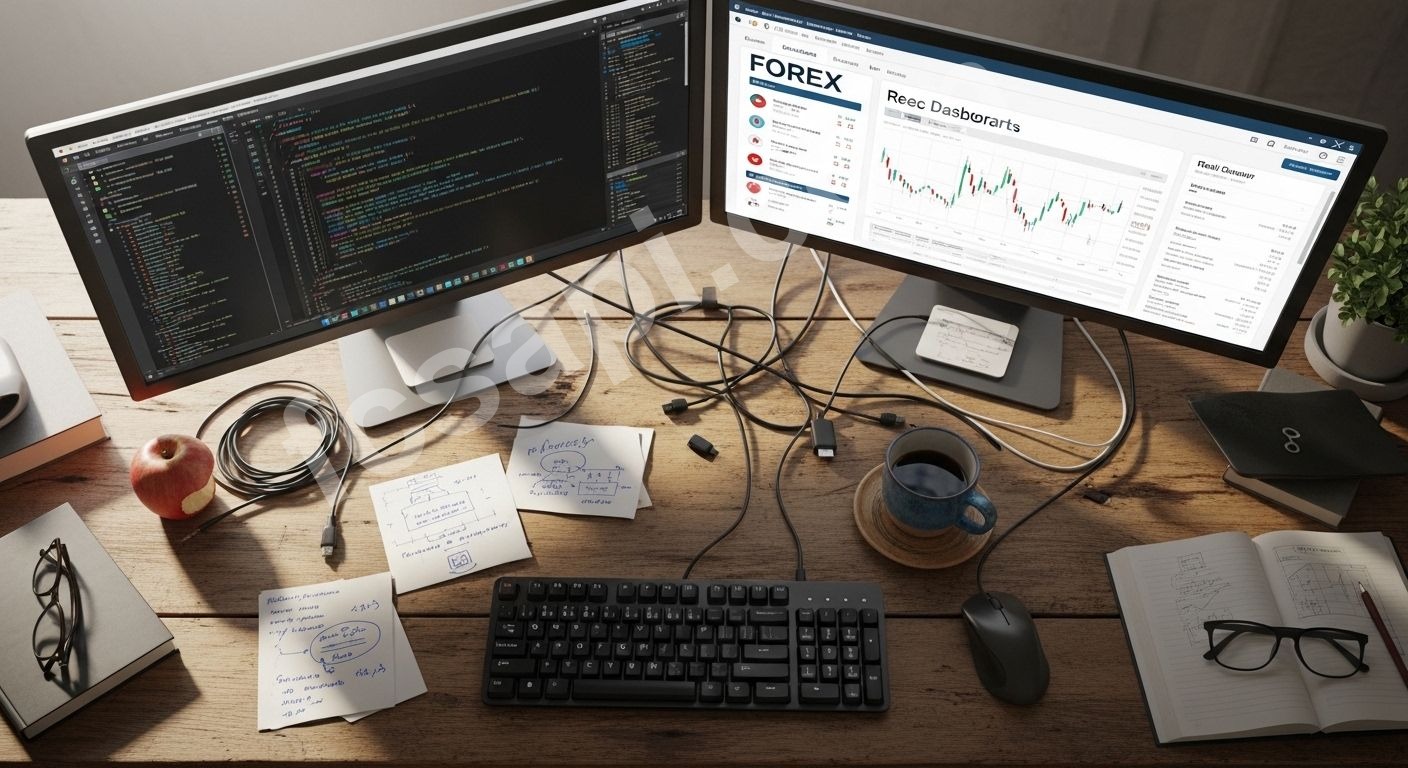
Visualizing Real Risk, Not Just P&L
This is where your custom dashboard truly earns its keep. Most platforms just show you P&L. Who cares? That’s after the fact. You need to visualize the potential P&L, and more importantly, the potential loss. That's the real differentiator.
Build a real-time volatility meter for your pairs. Use heatmaps to show which pairs are experiencing abnormal spreads. Display your effective stop-loss level, including a buffer for slippage, right next to your entry price. Don’t just assume your theoretical stop will hold. The market doesn't care about your theory.
I learned this hard lesson on a high-impact news event. My stop was in place, I felt safe. But the slippage on that particular broker, during that specific event, was brutal. My 1% loss limit turned into a 3.5% hit. A custom dashboard showing me that slippage risk in real time, or even historical maximum slippage for that pair during similar events, would have changed my strategy completely. Visualizing these invisible risks is key.
My Blunders: Latency, Data Quality, and False Security
I’ve made all the mistakes. Thinking I was clever, trying to save a few bucks. I once hosted my dashboard on a cheap VPS half a continent away from my actual trading servers. The network latency, the round trips to the API, then back to my backend, then to my frontend – it all piled up. My "real-time" dashboard was often a full second or more behind the market. You don’t make money reacting to stale news.
Data quality is another killer. Even with a premium API, your processing can mess it up. Are you checking for null values? Are you catching sudden, impossible price spikes (bad data from an upstream source can happen)? I once built a custom indicator that went berserk because of one bad tick, showing me a 'strong buy' signal based on absolute garbage. Chased that signal for a quick loss before realizing the underlying data was corrupt.
The worst mistake? Feeling secure. Thinking because I built it myself, it was infallible. It’s not. It’s software. It breaks. APIs change, network routes fluctuate, your own code has bugs. Constant monitoring, constant vigilance. This isn't a "set it and forget it" kind of deal. You're building a tool for war, not a toy.
Setting Up Alerts: Your Safety Net (and Lucky Break)
Don't just stare at the screen. You’re building a dashboard, not an art gallery. Your dashboard needs to talk to you, actively. Set up robust, immediate alerts. I'm talking SMS, push notifications, whatever it takes to get your attention.
Threshold alerts for price movements, sudden volume spikes, abnormally widening spreads. If EUR/USD suddenly jumps 70 pips in 15 seconds against market expectations, you need to know immediately. This isn’t just about protecting profits; it’s about preventing catastrophic losses. Your platform might freeze, your internet might cut out. But an independent alert system can be your last line of defense.
I had a close call one time, system crashed, broker platform went offline. Panic. But my custom alert, running off the FCS API data independently, pinged my phone: "GBP/JPY spread > 10 pips!" I knew something was severely wrong, fast. Got out of a chunky position with minimal damage. That alert saved my skin. Worth every line of code I wrote.
Scaling for Tomorrow, Today
Think about 2026. What’s going to change? Everything. Your dashboard needs to be built with scalability in mind. More pairs? More data points? More users if you ever decide to share? Your current setup might work for a handful of pairs, but what happens when you want to track twenty, thirty simultaneously? Check the `Pricing` for your API plan; don't get throttled just when things get interesting.
Keep your code modular. Make updates easy. APIs evolve, new features drop. You want to integrate those without rebuilding the whole thing from scratch. The trading landscape isn't static, and neither should your tools be. I read the `Blog` regularly for updates and trends, helps stay ahead. The less friction to adapt, the better.
Building a forex dashboard with this API in 2026 isn't just a coding exercise; it's an investment in understanding the market's true volatility and your own risk.
In 2027, the line between data and AI-driven insights will blur even further, demanding even more robust and adaptable custom dashboards.