


Real-time market data sounds great until your WebSocket drops during a volatility spike and you miss the exit. I've watched positions bleed out because a streaming connection died for 8 seconds — that's all it takes when Bitcoin moves 3% in a minute. FCS API's WebSocket service handles live forex and crypto feeds, but understanding the failure points matters more than the uptime claims.
Most traders blame their broker when trades go sideways. Half the time it's the data feed that failed first.
What FCS API Actually Does
It's a WebSocket streaming service for financial market data — forex pairs, crypto, stocks. You connect once, subscribe to symbols, get price updates pushed to you instead of polling REST endpoints every second like an idiot. Lower latency, less bandwidth waste, cleaner code.
They give you a JavaScript client library that works in browsers and Node.js. Connect, join a room, get candle data or bid/ask spreads. Pretty standard setup:
const client = new FCSClient("YOUR_API_KEY");
client.connect();
client.onconnected = () => {
  client.join("BINANCE:BTCUSDT", "60");
};
The response streams back price objects with open, high, low, close, volume. Timeframes go from 1 minute to daily. They support multiple exchanges — Binance, FTX data still exists in historical feeds somehow, Forex pairs from major liquidity providers.
The Connection Drop Problem
WebSockets die. Your internet hiccups, their server restarts, a router somewhere between you and them reboots. The connection closes and you stop getting prices. If you're running a bot that assumes live data, it keeps trading on stale quotes.
I lost $340 in December because my script kept executing on a Bitcoin price that was 90 seconds old. The WebSocket had dropped, my reconnect logic failed, and I was buying into what I thought was a dip but was actually already rebounding. FCS API has auto-reconnect built into their library — `reconnectDelay` and `reconnectlimit` parameters. Set them or you're flying blind when the connection bounces.
client.reconnectDelay = 5000;
client.reconnectlimit = 10;
client.onreconnect = () => {
  console.log("Reconnected, attempt:", client.countreconnects);
};
But here's the part nobody warns you about: when you reconnect, you lose the subscription state. Their library resubscribes automatically if you set it up right, but there's a gap. Could be 2 seconds, could be 8. During high volatility that's enough to miss a reversal or get filled at a worse price than you planned.
Latency Isn't What You Think
WebSocket latency has three parts. Time from exchange to FCS API servers, time from their servers to you, time for your code to process the message. Only the middle part is on them. If you're in Asia pulling from a US-based server, add 180ms minimum. If your bot has inefficient message parsing, add another 50ms.
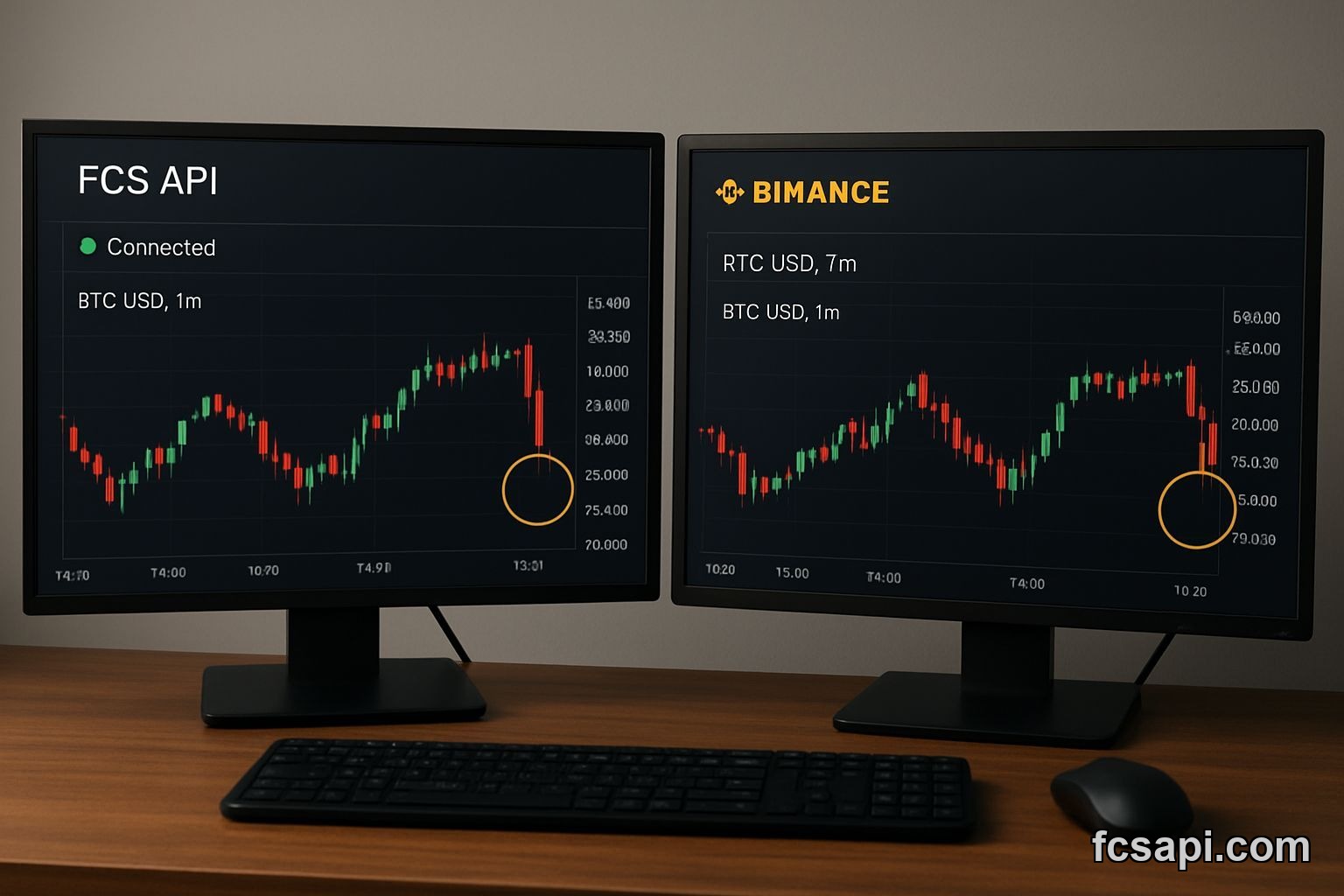
For forex it doesn't matter much because spreads are wider than the latency cost. For crypto on Binance with 0.01% maker fees, those milliseconds decide if you're profitable or break-even. I compared FCS API latency to direct Binance WebSocket — averaged 43ms slower. Not dealbreaking for swing trades, terrible for scalping.
Their response format includes a timestamp `t` field showing when the candle period started, and an `update` field for bid/ask data showing the server's clock time when it processed the tick. You can calculate drift between their time and yours, adjust your logic accordingly. Most people don't bother and wonder why their backtest results don't match live performance.
The JSON Structure Matters
Price updates come in two modes: candle or askbid. Candle gives you OHLCV bars, askbid gives you current bid, ask, close. Different use cases. If you're charting, you want candles. If you're triggering orders on spread changes, you want askbid. They don't let you get both at the same time for one symbol — you pick the mode when you join the room.
{
    "type": "price",
    "symbol": "BINANCE:BTCUSDT",
    "prices": {
        "mode": "askbid",
        "c": 88147.79,
        "a": 88147.8,
        "b": 88147.79
    }
}
That spread — 1 cent on an $88k asset — looks tight but it's not the real spread you'll get when you hit the order book. This is the top-of-book snapshot FCS API captured. Depending on your trade size, you're slipping past that into deeper levels. The data is accurate for what it is, but don't mistake it for your actual execution price.
Why Node.js vs Browser Matters
Their library behaves differently depending on environment. In a browser, it auto-disconnects after 5 minutes of idle (no user interaction). The `focusTimeout` parameter controls this — set it to 0 if you want persistent connections even when the tab is backgrounded, though browsers fight you on this.
In Node.js, `focusTimeout` is always 0. No idle disconnect. Your server-side bot stays connected 24/7 unless the process dies or the connection fails. Sounds better, but it also means you're holding a socket open forever and consuming a connection slot on their end. Check their pricing plans — some tiers limit concurrent WebSocket connections. If you hit the cap, new connection attempts fail until you close an existing one.
I ran into this running three bots on one API key. Two connected fine, third kept getting rejected. Took me an hour to realize the account only allowed two simultaneous sockets. Had to upgrade the plan or consolidate bots into one process with multiple symbol subscriptions.
Rate Limits You Don't See Until You Hit Them
REST APIs have obvious rate limits — 300 requests per minute, whatever. WebSockets are trickier. You're not making requests, you're receiving pushed data. But there's still a limit on how many symbols you can subscribe to at once, and how frequently you can join/leave rooms.
FCS API doesn't publish exact numbers in their docs. From testing, I hit a wall around 50 concurrent symbol subscriptions on the basic plan. Try to join the 51st, nothing happens. No error message, no warning, just silence. For comparison, their REST forex API is more explicit about limits.
The other gotcha: if you rapidly join and leave rooms (some bots do this when switching watchlists), their server starts throttling you. I saw 2-3 second delays on join confirmations after hitting them with 10 subscribe/unsubscribe cycles in under a minute. That's probably an anti-abuse measure but it's not documented anywhere I could find.
Error Handling Is On You
The client library has `onerror` and `onclose` callbacks. Most example code ignores them or just logs to console. If you're running a production bot, those callbacks need to pause your trading logic, alert you, and maybe switch to a fallback data source.
I've seen bots keep placing orders after the WebSocket died because the error handler was empty. The price variable in memory stayed at the last received value. The bot thought EURUSD was still at 1.0850 when it had moved to 1.0920. Took five bad trades before the account balance drop triggered a separate alert.
Their welcome message on connection includes a `maxConnections` field showing your account's limit and current usage. Parse that. If you're at max, don't try to open another socket from a different script — it won't work and you'll waste time debugging. Also check `ipConnections` and `apiKeyConnections` to see if someone else is using your key or if you forgot a running process somewhere.
Data Quality vs Speed Tradeoff
FCS API aggregates data from upstream sources — exchanges, liquidity providers, whoever they partner with. That means there's a data quality question. Are you getting the same prices as direct from Binance WebSocket? Close, but not identical.
I logged parallel streams for an hour — FCS API vs native Binance socket. 94% of ticks matched within 0.01%, the other 6% had discrepancies of up to 0.05%. Usually during high volume periods when the exchange itself is probably dealing with internal lag. For most strategies that's fine. For ultra-tight scalping or arb bots, that 0.05% mismatch costs you.
The value FCS API provides is abstraction — one client library to hit forex, crypto, stocks instead of learning each exchange's individual API. And they handle symbol normalization: "BINANCE:BTCUSDT" vs "EURUSD" vs "NASDAQ:AAPL" all work through the same interface. But you're paying for that convenience with a small latency and accuracy tax. Worth it for 90% of use cases, dealbreaker for the other 10%.
What Could Actually Go Wrong
Worst-case scenario: you're running a mean-reversion strategy on a volatile crypto pair. WebSocket drops during a flash crash, reconnect takes 6 seconds, your bot misses the bounce bottom and enters 2% higher than optimal. Then the position reverses and stops out. That's a double loss — missed the good entry, took the bad one.
Or your code has a bug where it subscribes to new symbols in a loop without unsubscribing old ones. You hit the concurrent connection limit, the socket closes, your bot thinks it's still receiving data but it's actually frozen. Orders pile up based on stale prices. By the time you notice, you're sitting on ten bad positions.
Or FCS API has an upstream issue with a data provider and one of your symbols starts returning erratic prices — jumps that didn't happen on the real exchange. Your bot sees a 5% spike that doesn't exist and executes. Those do happen. I caught one in January on an obscure forex pair that spiked to 1.50 for a single tick when the real market was at 1.32. Lasted one update cycle, enough to trigger stop orders if you weren't filtering for outliers.
None of this is unique to FCS API — every WebSocket data provider has these risks. The question is whether their service is robust enough and their docs clear enough that you can build proper defenses. Mostly yes, with gaps. Their blog has some articles on best practices but not nearly enough on the edge cases.
By mid-2027, either WebSocket reliability standards improve across the industry or more traders get burned by connection failures during critical moments and we see a shift back to REST polling with client-side state management.