
Integrating cryptocurrency data into a website, mobile application, or trading platform should not be a complicated process. Developers need reliable access to cryptocurrency prices, market trends, historical data, and other essential information without spending weeks understanding complex API structures. This is why choosing an easy-to-integrate Crypto API is an important decision for businesses, developers, and financial technology companies.
A Crypto API allows applications to communicate with cryptocurrency data providers and retrieve information automatically. Instead of collecting prices manually from different exchanges, developers can connect their applications to an API and receive structured market data through simple requests.
However, not every cryptocurrency API offers the same integration experience. Some require complicated authentication procedures, extensive configuration, or advanced programming knowledge. Others provide straightforward endpoints, clear documentation, and standardized responses that make development significantly easier.
Platforms such as FCS API offer cryptocurrency market data alongside financial information covering stocks, forex, commodities, ETFs, and indices. Understanding what makes an API easy to integrate can help developers choose a solution that supports both their immediate requirements and future application development.
What Makes a Crypto API Easy to Integrate?
The easiest Crypto API is not necessarily the one with the fewest features. Instead, it is the API that allows developers to access the information they need with minimal technical complexity.
Several factors influence the integration process, including documentation quality, authentication methods, response formats, programming language compatibility, and the availability of useful endpoints.
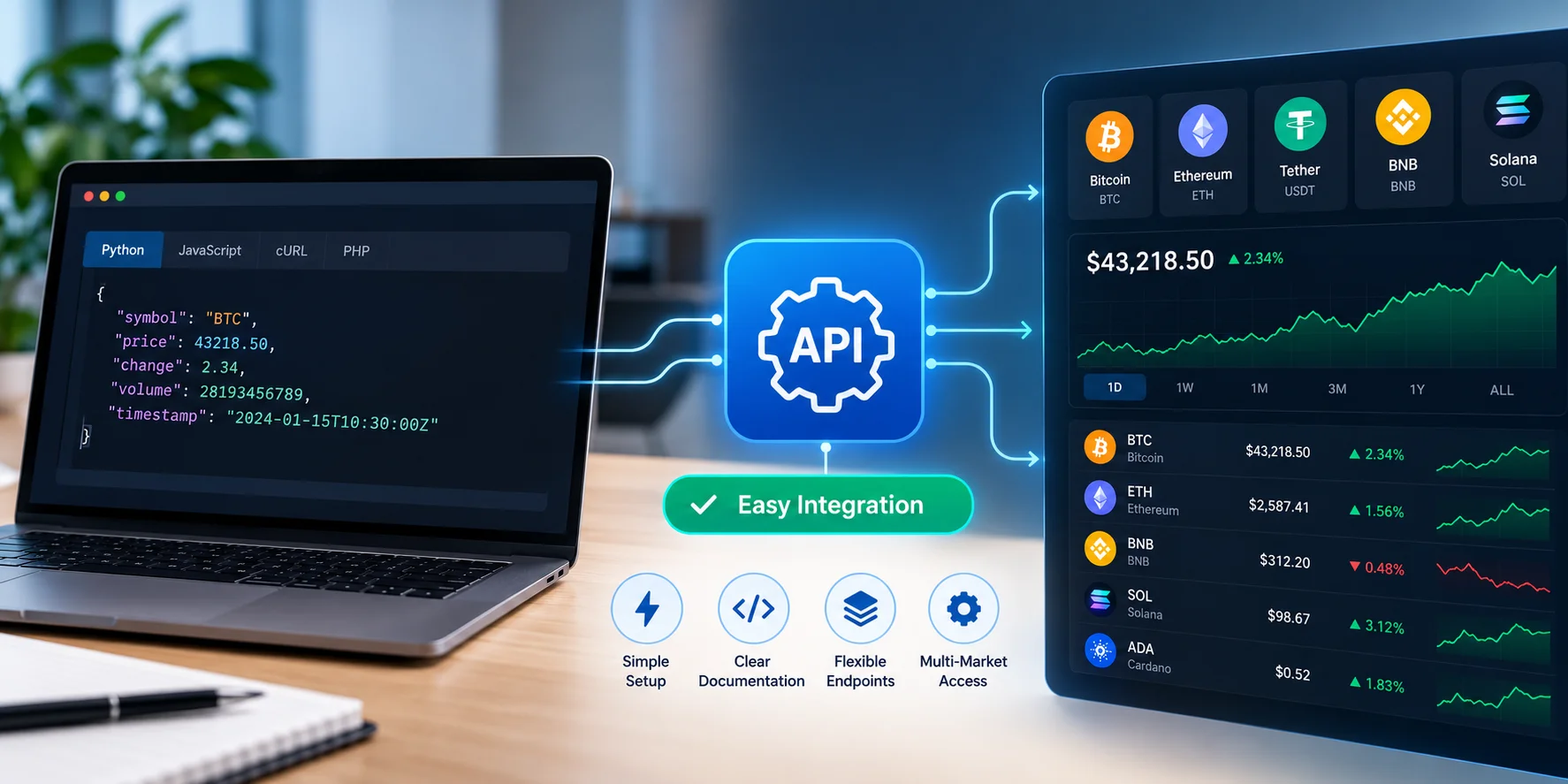
For example, an API that returns cryptocurrency prices in JSON format can be easier to work with because JSON is supported by most modern programming languages. Developers can retrieve the information, process the response, and display the results without creating complicated data conversion systems.
Similarly, clearly organized endpoints help developers understand how to request specific information. An endpoint for cryptocurrency prices should be easy to identify, while separate endpoints for historical prices or market information should follow consistent naming and response structures.
Another important consideration is the time required to complete the first successful API request. Developers should ideally be able to understand the documentation, configure authentication, send a request, and receive usable cryptocurrency data within a short period.
An API that simplifies these steps can reduce development time and make future maintenance more manageable.
Which Crypto APIs Are Commonly Used by Developers?
Several cryptocurrency data providers offer APIs designed for different development requirements. Popular options include CoinGecko, CoinMarketCap, CryptoCompare, Binance, and FCS API.
CoinGecko is commonly considered by developers building cryptocurrency tracking applications, portfolio dashboards, and market information websites. Its API provides access to cryptocurrency prices, market capitalization, trading volumes, and historical information.
CoinMarketCap offers cryptocurrency market data that can support financial dashboards, analytics platforms, and applications requiring information about digital assets.
CryptoCompare provides cryptocurrency pricing and historical market information that developers can use for analytical tools and market monitoring applications.
Binance offers APIs associated with its cryptocurrency exchange. These can be useful for applications requiring exchange-specific market data, account functionality, or trading capabilities. However, integrating trading functionality may involve additional authentication, permissions, and security requirements.
FCS API is another option for developers exploring cryptocurrency data integration, particularly when their applications also require information from other financial markets.
Each provider serves different requirements. A simple cryptocurrency price tracker may need only a few endpoints, while a comprehensive financial platform may require access to multiple asset classes.
Therefore, the easiest API depends on the type of application being developed and the features that must be supported.
Why Is REST API Integration Popular for Cryptocurrency Applications?
REST APIs are widely used because they provide a familiar method for exchanging information between applications and servers.
Most REST-based cryptocurrency APIs use standard HTTP requests to retrieve market information. Developers send a request to an endpoint, and the server returns a response containing the requested data.
For example, a cryptocurrency tracking application might request the latest Bitcoin price. The API processes the request and returns structured information that the application can display to users.
This approach works with many programming languages, including Python, JavaScript, PHP, Java, and C#.
REST APIs are particularly suitable for websites, financial dashboards, mobile applications, and systems that retrieve cryptocurrency information at regular intervals.
Developers can also use established HTTP libraries rather than creating custom communication systems.
However, REST APIs are not always the best solution for every requirement. Applications that need continuous market updates with minimal delay may benefit from WebSocket connections when supported by the provider.
For most basic cryptocurrency information applications, a well-documented REST API offers a practical starting point.
How Does FCS API Support Cryptocurrency Data Integration?
FCS API is a financial information platform that provides API access to market data covering cryptocurrencies, stocks, forex, commodities, ETFs, and indices.
For developers building financial applications, access to multiple markets through one provider can simplify the overall data sourcing process.
Consider a financial dashboard that displays Bitcoin prices, major currency pairs, stock market information, and commodity trends. Using separate providers for every asset category may require developers to manage multiple accounts, authentication systems, billing arrangements, and response structures.
A multi-asset financial API can help reduce some of this complexity by bringing different types of market information into a more centralized integration environment.
FCS API can be considered for cryptocurrency tracking websites, financial market dashboards, portfolio monitoring tools, and applications that combine digital assets with traditional financial instruments.
Developers evaluating FCS API should review its available cryptocurrency endpoints, authentication requirements, documentation, supported assets, data update frequency, and subscription conditions before beginning integration.
This helps determine whether the platform matches the application's technical requirements and expected usage.
For projects that may expand beyond cryptocurrencies, choosing a provider with broader financial market coverage can also support future development without requiring a complete change in data sourcing strategy.
How Can Developers Integrate a Crypto API Step by Step?
Integrating a cryptocurrency API generally follows a straightforward development process, although the exact steps depend on the provider.
The first step is selecting a suitable API platform and creating an account. Developers should examine the available endpoints and determine whether the provider supports the cryptocurrency information their application requires.
After registration, the next step is obtaining an API key. This key identifies the application when it sends requests to the provider. API keys should be stored securely on the server rather than exposed in publicly accessible frontend code.
Once authentication is configured, developers can send their first request.
For example, a developer using a cryptocurrency price endpoint can request market information for a specific trading pair, such as BTC/USDT. The API processes the request and returns the available information in a structured response.
After receiving the information, developers can extract relevant values and display them in their applications. These might include cryptocurrency prices, price changes, or other market information available through the selected endpoint.
The final step involves testing the integration. Developers should verify successful responses, handle errors, manage request limits, and confirm that the displayed information updates as expected.
Why Are Documentation and Code Examples Important?
Documentation is one of the most important factors when evaluating the ease of cryptocurrency API integration.
Even an API with powerful features can become difficult to implement when developers cannot understand its parameters, authentication requirements, or response structures.
Good documentation explains what each endpoint does, which parameters are required, what information the response contains, and how errors should be handled.
Code examples are particularly valuable because they demonstrate how an API request works in a real programming environment.
FCS API provides cryptocurrency API documentation with examples for popular programming languages, helping developers understand how to connect applications with financial market data.
For beginners, these resources reduce the amount of time spent learning unfamiliar technical concepts. Experienced developers also benefit because they can adapt existing examples rather than building every request from scratch.
Before selecting a provider, developers should examine whether its documentation includes authentication instructions, endpoint references, example responses, error handling guidance, and practical integration examples.
Can Beginners Integrate a Crypto API Without Advanced Programming Knowledge?
Beginners can integrate many cryptocurrency APIs with basic programming knowledge, especially when the provider offers clear documentation and simple HTTP endpoints.
A developer familiar with Python or JavaScript can begin by learning how to send an HTTP request and read a JSON response.
For example, a basic cryptocurrency price application needs to request market information, identify the required price value, and display it on a webpage.
This process does not necessarily require advanced financial knowledge or complicated software architecture.
However, beginners should understand a few important technical concepts before developing production applications.
These include API authentication, HTTP response codes, JSON data structures, request limits, and error handling.
Developers should also understand the difference between retrieving information and executing trades. A cryptocurrency market data API provides information, while an exchange trading API may allow applications to place orders or manage accounts.
Trading integrations generally require additional security measures and more careful testing.
Starting with a basic price-tracking application is often the easiest way to understand cryptocurrency API integration before moving toward more advanced financial software.
What Should Developers Consider Before Choosing a Crypto API?
Integration simplicity is important, but developers should also evaluate whether an API can support the application's long-term requirements.
Data coverage is one consideration. Some applications need information about major cryptocurrencies such as Bitcoin and Ethereum, while others require a much broader selection of digital assets.
Historical data availability is another factor. Applications that display price charts or analyze previous market movements need access to historical records rather than only current prices.
Update frequency also matters. A general financial information website may not require the same update frequency as a system monitoring rapid cryptocurrency price movements.
Developers should examine API rate limits, subscription plans, response times, and available technical support.
Security and reliability should also be considered. Applications should handle unavailable endpoints, invalid responses, and temporary connection failures without disrupting the entire user experience.
For projects that combine cryptocurrencies with traditional financial assets, multi-market coverage can be especially valuable.
FCS API provides access to cryptocurrency and other financial market information, making it a relevant option for developers considering broader financial data integration.
Which Crypto API Is the Best Choice for Easy Integration?
The easiest Crypto API depends on the application's purpose, the developer's experience, and the type of information required.
For a cryptocurrency-only application, an API with straightforward price endpoints and comprehensive documentation may be sufficient. Providers such as CoinGecko offer developer resources for accessing cryptocurrency market information.