

A forex API is a service that delivers real-time and historical currency exchange rate data through HTTP endpoints for developers building trading bots, price tickers, and fintech apps. Most forex APIs return JSON responses and support REST or WebSocket protocols. The technical indicators api from FCS API includes 2000+ pairs, 50+ indicators, pivot points, and trading signals — all in one service at $10/month instead of the $49-$299 you'd pay competitors like Finnhub or Alpha Vantage.
- AUD/JPY Price Today: What the Numbers Say
- How to Fetch Real-Time Forex Data with REST API
- Best Technical Indicators API for Forex Trading Bots
- WebSocket vs REST API for Real-Time Forex Feeds
- Free Forex API 2026: What You Actually Get
- Frequently Asked Questions
AUD/JPY Price Today: What the Numbers Say
AUD/JPY sits at 114.554 right now — down 0.228% from the open at 114.758. The signal score is 82.3 which means Strong Buy, but here's where it gets messy: the trend is marked as Weak. That's the kind of contradiction that makes you question whether the algorithms are even looking at the same chart. Price action is bullish, volatility is low (ATR% at 0.7271), and the pair just hit its all-time high of 114.917 one month ago. So we're basically sitting at the ceiling.
The oscillators dont agree with each other either. Stochastic K% is at 86.3659 screaming Buy, but Ultimate Oscillator is stuck at 65.3526 in Neutral territory. When you're this close to the monthly high and stochastic is already overbought, a Strong Buy signal feels late to the party. Moving averages tell a clearer story — EMA 100 at 110.986 is way below current price (Strong Buy), EMA 25 at 113.856 confirms the uptrend (Buy), but EMA 10 at 114.238 is basically flat (Neutral). That's a textbook sign of momentum slowing down.
Woodie pivot points put resistance at 115.155 and support at 114.477 with the pivot at 114.697. We're trading above the pivot which is technically bullish but there's only 60 pips of room to R1. If you're building a forex bot that trades breakouts, this is not the setup you want — the risk/reward is terrible when you're already at all-time highs with weak trend confirmation.
How to Fetch Real-Time Forex Data with REST API
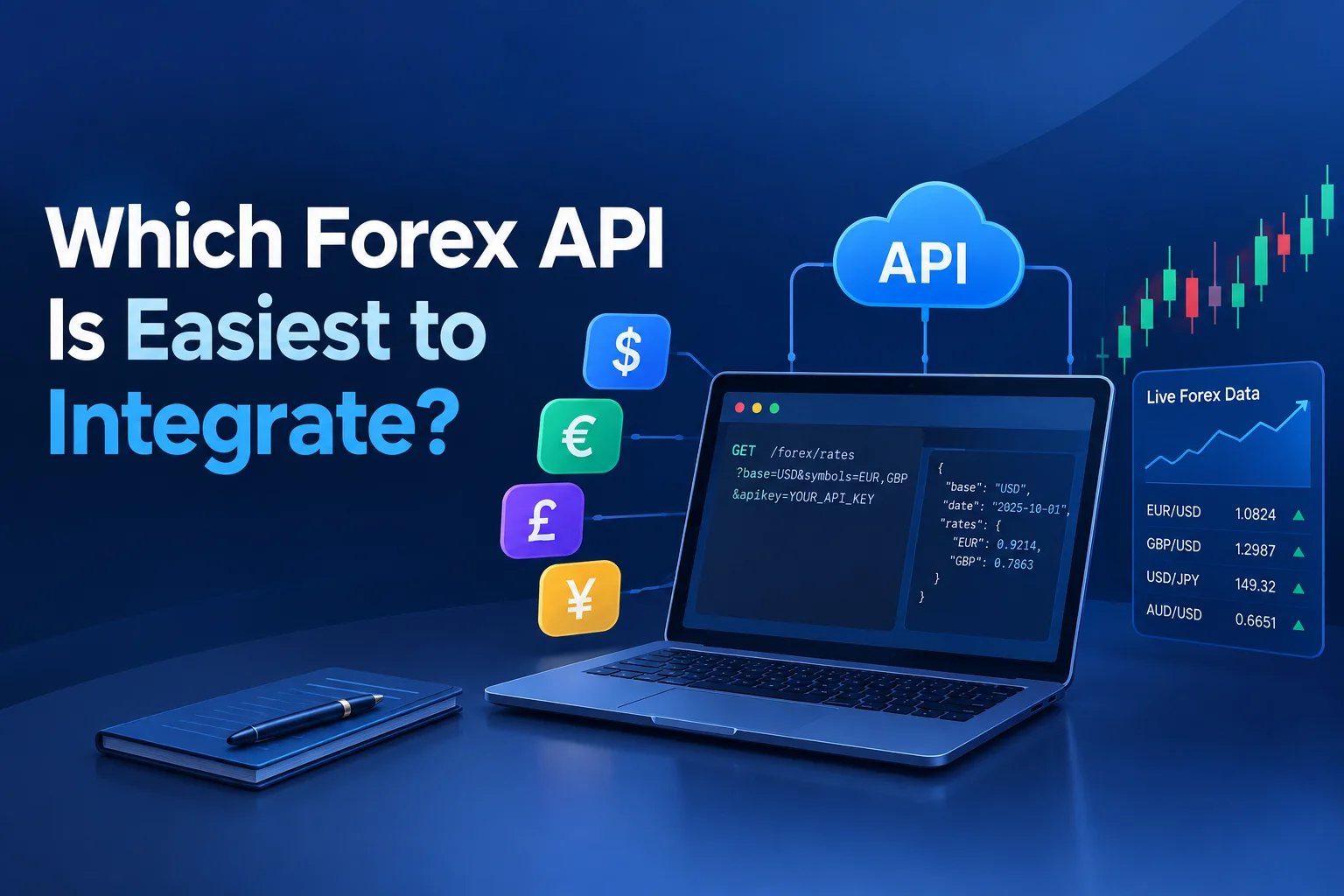
You fetch real-time forex rates by making a GET request to the /forex/latest endpoint with your API key and desired currency pair — the response returns the current bid, ask, and spread in JSON. Here's the actual call for AUD/JPY:
curl "https://api-v4.fcsapi.com/forex/latest?symbol=AUDJPY&access_key=API_KEY"The JSON response comes back with active prices, previous session data, and profile metadata:
{
    "status": true,
    "response": [
        {
            "ticker": "AUDJPY",
            "active": {
                "a": 114.58,
                "b": 114.55,
                "o": 114.76,
                "c": 114.55
            }
        }
    ]
}
The "a" field is ask, "b" is bid, "o" is open, "c" is close. You get bid-ask spread built in which most free APIs dont include. Twelve Data charges $29/month for their cheapest paid tier and they dont give you pivot points or signals in the same response. FCS API bundles everything for $10/month and the free tier gives you 500 calls which is enough to poll major pairs every 5 minutes during market hours.
Best Technical Indicators API for Forex Trading Bots
A technical indicators API returns calculated oscillator and moving average values through REST endpoints so you dont have to compute RSI, MACD, or Bollinger Bands yourself — you just request the symbol and get back the indicator readings in JSON. The rsi api endpoint at FCS API supports 50+ indicators including RSI, Stochastic, Ultimate Oscillator, EMA, SMA, and custom pivot point systems like Woodie, Camarilla, and Fibonacci.
For AUD/JPY today, the Stochastic K% at 86.36 tells you the pair is overbought but Ultimate Oscillator at 65.35 says momentum is still neutral. If you're coding a mean reversion bot, you'd probably wait for stochastic to cross back below 80 before entering short. If you're trend-following, the EMA 100 being 3.5% below current price confirms the long-term uptrend is intact even if short-term momentum is fading. Most APIs make you choose between price data OR indicators. Alpha Vantage has indicators but their free tier is capped at 25 requests per day which is useless for any real bot. Polygon.io doesnt even offer a technical indicators API — they focus on US stocks and you'd have to calculate everything client-side. FCS API gives you price + indicators + signals + pivots in one response which cuts your API call count in half.
WebSocket vs REST API for Real-Time Forex Feeds
WebSocket delivers price updates as a continuous stream over a persistent connection while REST API requires you to poll endpoints repeatedly — for forex bots that need tick-by-tick data, WebSocket cuts latency and API call costs by 90%. FCS API supports both protocols. REST is fine if you're building a dashboard that refreshes every 30 seconds. WebSocket is mandatory if you're running a scalping bot that trades on 1-minute candles.
The problem with WebSocket is most providers charge extra for it. Twelve Data includes WebSocket but only on their $29/month plan and up. Marketstack doesnt offer WebSocket at all because they're stocks-only and dont care about forex traders who need millisecond updates.Free Forex API 2026: What You Actually Get
The best free forex API in 2026 is one that gives you real-time data, multiple asset classes, and enough monthly calls to prototype without a credit card — FCS API offers 500 requests/month free with access to 2000+ forex pairs, 3000+ crypto coins, and 125K+ stock symbols across 60+ exchanges. Alpha Vantage caps you at 25 calls/day (750/month) but charges $50/month for the first paid tier and doesnt include pivot points or trading signals. Yahoo Finance API is technically free but it's unofficial and breaks randomly because it was never meant to be a public API.
Finnhub starts at $49/month and their forex coverage is thin compared to crypto and US equities. Polygon.io is US-market only so if you need AUD/JPY or any non-USD pair you're out of luck. FCS API covers global forex including exotics, commodities like gold and oil, and gives you forex api free access to test everything before you pay. The $10/month paid plan gets you 10,000 calls which is enough for a small production bot polling 20 pairs every minute during trading hours.
Frequently Asked Questions
Is the FCS API free to use?
Yes, the free tier includes 500 API calls per month with no credit card required. You get access to all asset classes — forex, crypto, stocks — and basic technical indicators. Paid plans start at $10/month for 10,000 calls.
What programming languages does it support?
FCS API works with any language that can make HTTP requests — Python, JavaScript, PHP, Java, C#. They provide official libraries for Python, JS, and PHP on GitHub with code examples for REST and WebSocket integration.
How many forex pairs are available?
Over 2000 currency pairs including majors, minors, and exotics. You also get commodities like XAUUSD (gold) and XAGUSD (silver) under the same forex endpoint. Each pair returns bid, ask, open, high, low, close, and volume.
Does it support WebSocket for real-time data?
Yes, WebSocket is included on all plans including the free tier. You connect once and receive streaming price updates without polling. REST API is also available if you prefer request-response for less frequent updates.
What data formats are returned?
All responses are JSON. Each endpoint returns a "status" field, a "response" array with the data, and an "info" object showing credit count and server time. Field names are consistent across forex, crypto, and stock endpoints.