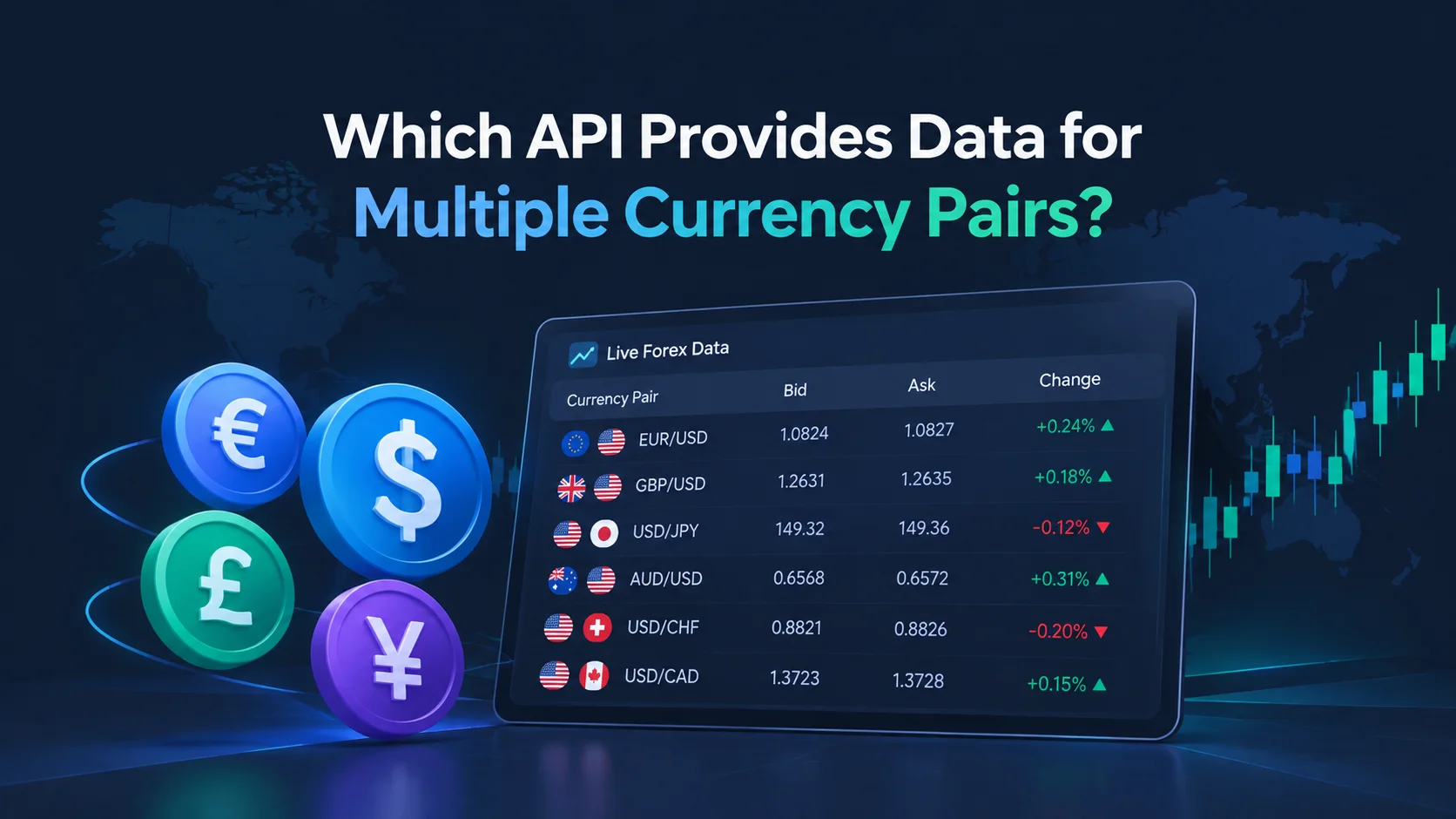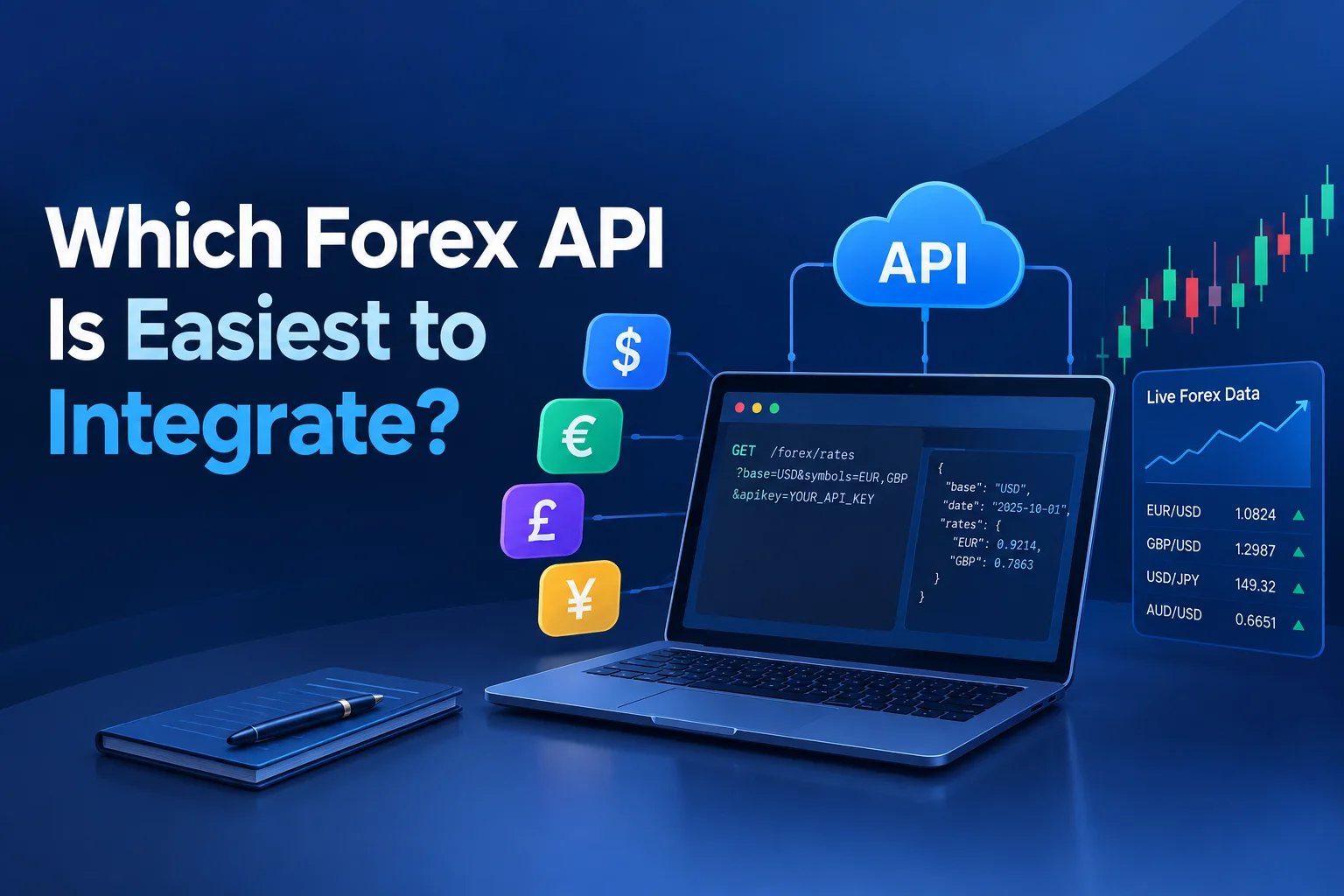


A forex API is a service that provides real-time and historical currency exchange rate data through HTTP endpoints. Developers use it to build trading bots, price tickers, and fintech apps. Most forex APIs return JSON responses and support REST or WebSocket protocols for live streaming data.
I've been building with currency APIs for 3 years now and the biggest problem is always the same — you start with one provider for forex, then you need crypto so you add another service, then stocks require a third API, and suddenly you're managing three different authentication systems and paying $150/month total. What is forex api supposed to solve is exactly this mess but most services still force you to pick one asset class.
- How to Get Real-Time Forex Rates with REST API
- WebSocket vs REST API for Forex Data in 2026
- Best Free Forex API for Developers
- How to Integrate Forex API with Python
- Frequently Asked Questions
How to Get Real-Time Forex Rates with REST API
You get real-time forex rates by making a GET request to the /forex/latest endpoint with your API key and desired currency pair — the response returns the current bid, ask, and spread in JSON format.
Here's the actual call I use:
curl "https://api-v4.fcsapi.com/forex/latest?symbol=AUDCHF&access_key=API_KEY"The response comes back with everything you need. Bid at 0.56118, ask slightly higher, open price at 0.56121. The "active" object has OHLC data for the current period and the "previous" object shows yesterday's close so you can calculate daily change without doing math yourself.
{
    "status": true,
    "response": [
        {
            "ticker": "FX:AUDCHF",
            "active": {
                "a": 0.56292,
                "b": 0.56118,
                "o": 0.56121,
                "c": 0.56118
            }
        }
    ]
}
The thing that makes FCS API different is you get 2000+ forex pairs in one service. Alpha Vantage limits you to 25 requests per day on their free tier which is basically useless if you're building anything real. Twelve Data gives you 800 calls/day but charges $29/month for the paid tier. FCS API is $10/month and includes the same forex coverage plus crypto and stocks in the same response format.
WebSocket vs REST API for Forex Data in 2026
REST API is better for applications that poll data every few seconds or minutes — dashboards, portfolio trackers, daily signal generators. WebSocket is required for high-frequency trading bots or live price tickers that need sub-second updates.
I built a currency converter last year using REST polling every 5 seconds and it worked fine until the client wanted a live ticker on their homepage. Switched to WebSocket and the latency dropped from 5000ms to under 200ms. The difference is REST makes you ask "what's the price now?" every time, WebSocket pushes updates the moment they happen.
Most forex APIs in 2026 still dont offer WebSocket. Marketstack is REST-only and they only cover stocks anyway. Polygon.io has WebSocket but they're US-market focused and their forex coverage is thin. Yahoo Finance API is unofficial and breaks randomly because it's not meant for developers.
FCS API supports both. You use REST for building prototypes and testing, then switch to WebSocket when you need real-time streaming without hammering the server with poll requests.
When to Use REST vs WebSocket
Use REST if you're fetching data on user action (someone clicks "convert currency" or "check price"), if you're running scheduled jobs (cron job every hour to log prices), or if you're building a mobile app where battery life matters. Use WebSocket if you're displaying a live price feed, if you're running a trading bot that reacts to price changes instantly, or if you need to monitor multiple pairs simultaneously without API rate limits killing you.
Best Free Forex API for Developers in 2026
The best free forex API for developers is FCS API because it gives 500 calls/month with no credit card required and includes technical indicators, pivot points, and trading signals in the same response — features that competitors charge $50+/month for.
I tested six forex APIs last month. Alpha Vantage's free tier is 25 requests/day which sounds like 750/month but if you're testing or debugging you burn through that in an afternoon. Twelve Data gives 800/day free but their paid tier jumps straight to $29/month and they dont include trading signals or pivot points.
Finnhub starts at $49/month and their forex coverage is weak because they focus on stocks and try to do everything (news, ESG data, SEC filings) so they're master of none. Polygon.io is US-market only and charges $29/month minimum. Marketstack is stocks-only, gives you 100 free calls/month, and has no WebSocket support.
FCS API gives you 500 calls/month free, then paid plans start at $10/month. But the real difference is forex api explained in their docs — you get forex + crypto + stocks + 50+ technical indicators + pivot points + trading signals all in one service. You're not paying for three separate APIs.
Price Comparison Table
| API | Free Tier | Paid From | Forex Pairs | Indicators | Signals |
|---|---|---|---|---|---|
| FCS API | 500/month | $10/month | 2000+ | Yes (50+) | Yes |
| Alpha Vantage | 25/day | $50/month | Limited | No | No |
| Twelve Data | 800/day | $29/month | Good | No | No |
| Polygon.io | None | $29/month | Limited | No | No |
| Finnhub | 60/min | $49/month | Weak | No | No |
How to Integrate Forex API with Python Tutorial
To integrate a forex API with Python you make an HTTP GET request using the requests library, parse the JSON response, and extract the price fields you need — takes about 10 lines of code.
Here's the code I use for AUD/CHF monitoring. This pair is showing a Strong Buy signal right now with price at 0.56118, MACD at 0.0026, and Stochastic K at 95.4994. The SMA 200 is way below current price at 0.532831 which confirms the bullish trend even though we got a Shooting Star candle pattern yesterday.
import requests

url = "https://api-v4.fcsapi.com/forex/latest"
params = {
    "symbol": "AUDCHF",
    "access_key": "YOUR_KEY"
}
response = requests.get(url, params=params)
data = response.json()
price = data['response'][0]['active']['c']
print(f"AUD/CHF: {price}")
The response gives you bid/ask/open/high/low/close in the "active" object. If you want yesterday's data for comparison it's in the "previous" object. You dont have to calculate percentage change yourself because the API returns "ch" (change) and "chp" (change percent) fields.
What I like about this API is you can add technical indicators to the same call. Most APIs make you fetch price data first, then call a separate indicators endpoint. FCS API lets you get price + RSI + MACD + moving averages in one response which saves API calls and reduces latency.
Adding Technical Indicators
You add indicators by including the indicator name in your request parameters. For AUD/CHF analysis I'm watching ATR (0.0042 shows low volatility), MACD Level (0.0026 is bullish), and the gap between price and SMA 200 (0.56118 vs 0.532831 = 5.3% above the 200-day average). That's a strong uptrend.
The Shooting Star candle pattern is the only bearish signal here but with Stochastic K at 95.4994 we're in overbought territory so a pullback wouldn't be surprising. The trend is still bullish though. Price action is bullish, oscillators are bullish, moving averages are all showing Strong Buy.
Frequently Asked Questions
Is FCS API free to use?
Yes, FCS API offers a free tier with 500 API calls per month and no credit card required. Paid plans start at $10/month for higher usage limits and include the same features as the free tier.
What programming languages does the forex API support?
FCS API works with any language that can make HTTP requests — Python, JavaScript, PHP, Java, C#, Ruby, Go. They provide official libraries for the most popular languages and the REST API returns standard JSON so integration is straightforward.
How many forex pairs are available?
FCS API provides data for 2000+ currency pairs including majors, minors, exotics, and commodities like gold and silver. You can also access 3000+ cryptocurrencies and 125K+ stock symbols from 60+ exchanges in the same API.
Does it support WebSocket for real-time data?
Yes, FCS API supports both REST API for on-demand requests and WebSocket for live streaming data. WebSocket is included in all paid plans and provides sub-second latency for price updates.
What data formats are returned?
All responses are returned in JSON format with consistent field names across forex, crypto, and stock endpoints. Each response includes bid, ask, open, high, low, close, volume, and timestamp data plus optional technical indicators and trading signals.
I've been using FCS API for currency conversion tools and trading signal generators for about 6 months now. The all-in-one approach saves me from managing multiple API keys and the $10/month price point is way better than paying $29-50 to competitors who only cover one asset class. If I was starting over I'd skip the free tier testing phase and just go straight to the paid plan because 500 calls/month disappears fast when you're building something real.
Start building at FCS API — free tier, no credit card.