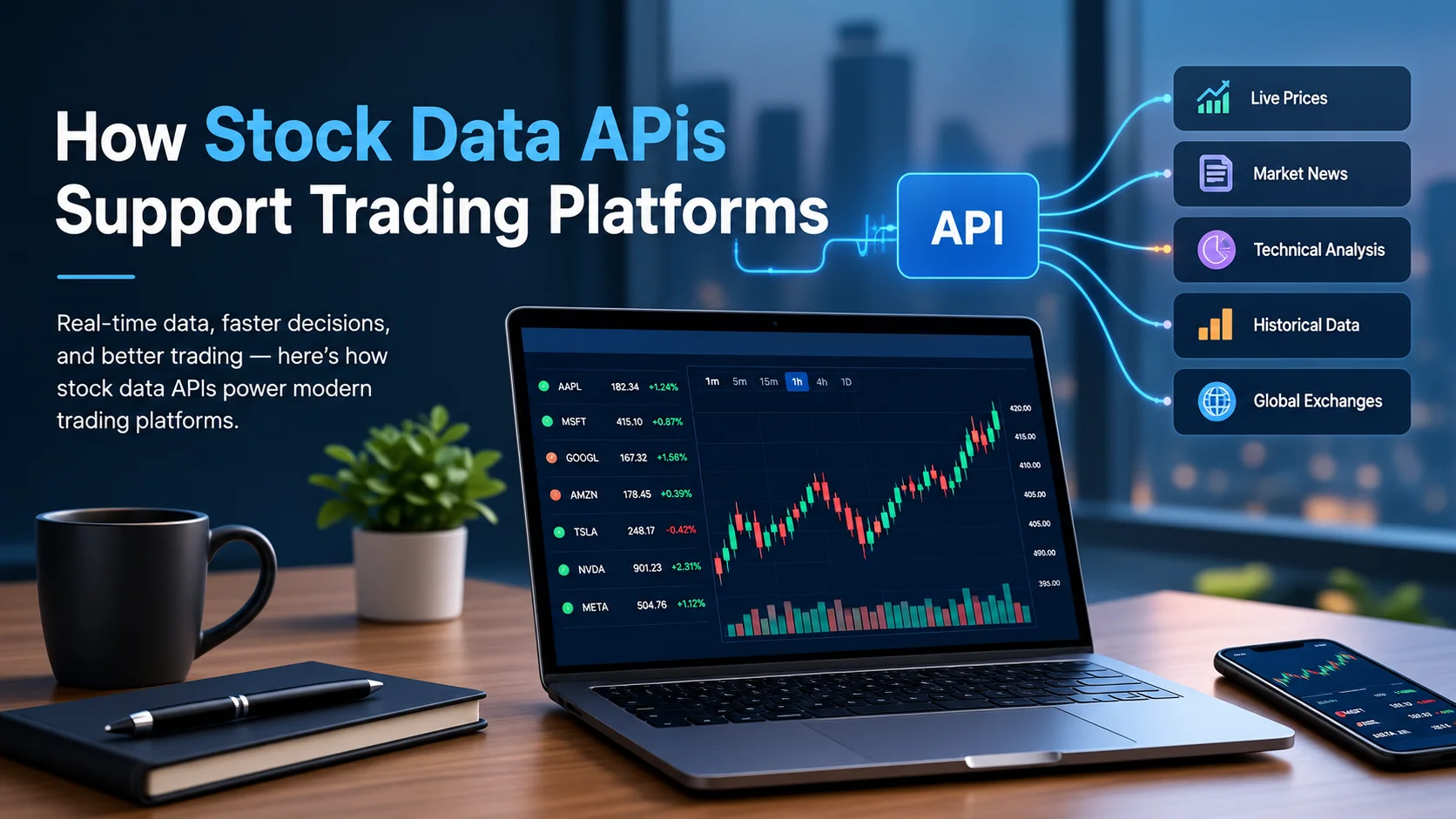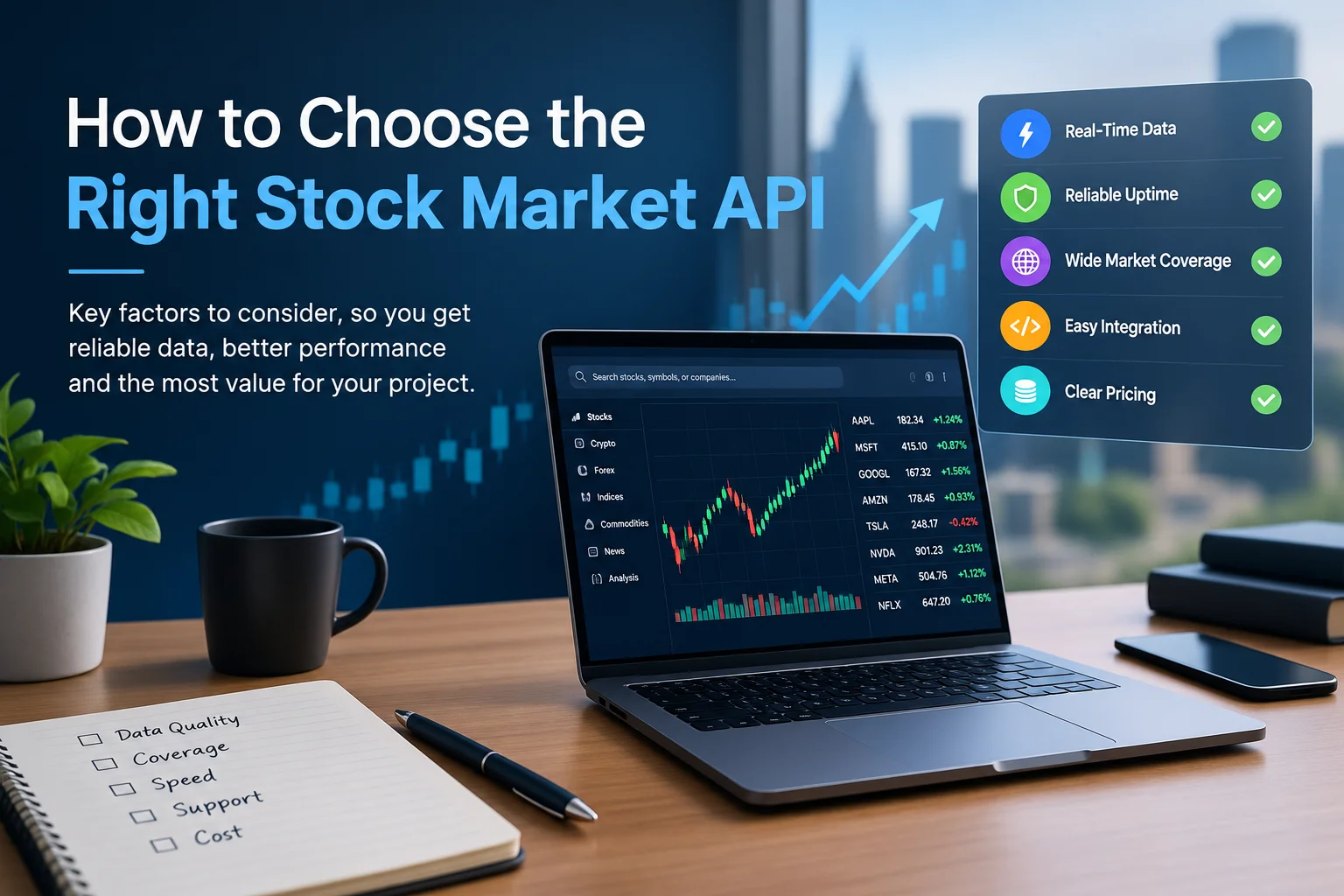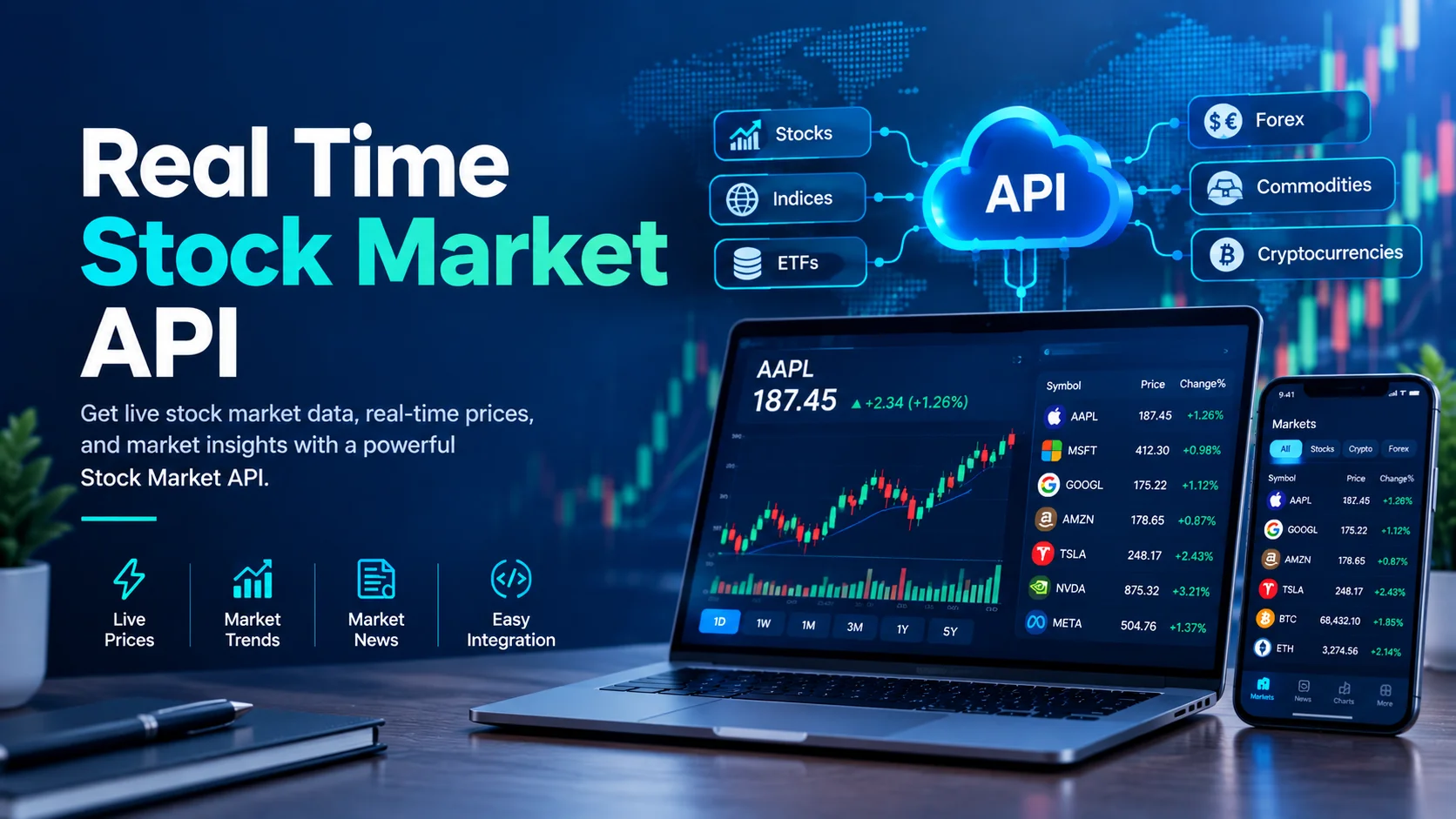


You need stock data. You Google "stock market API" and find a dozen options. They all promise real-time prices, historical data, global coverage. Then you read the fine print — rate limits that strangle your app after 500 calls, delayed data that's 15 minutes old, price tags that jump from $0 to $300 after your trial ends.
Why Most Stock APIs Fail Developers
I've tested every major stock API over the last three years. Most are garbage for serious projects. Best Free Stock Market Data API for Developers 2026 covers 125,000+ stocks across NYSE, NASDAQ, and 50+ global exchanges. No bait-and-switch pricing. No artificial delays on the free tier.
Here's what actually matters when you're building an app that depends on stock data.
Best Free Stock Market Data 2026: What You Get
The free tier isn't a demo — it's functional. 500 API calls per month. That's enough to prototype, test, build a portfolio tracker, or run a small side project. Real-time quotes for major exchanges. Historical data going back years. Profile details, indices, exchange lists.
You authenticate with a simple access key. No OAuth dance. No SDK required (though they have libraries for Python, JavaScript, PHP, Java, C# if you want them). Just curl and you're pulling data.
curl "https://api-v4.fcsapi.com/stock/list?country=united-states&access_key=API_KEY"Response comes back clean:
{
    "status": true,
    "response": [
        {
            "ticker": "NASDAQ:AAPL",
            "profile": {
                "symbol": "AAPL",
                "name": "Apple Inc.",
                "currency": "USD"
            }
        }
    ]
}
That's it. No nested objects 8 levels deep. No weird field names. Symbol, name, exchange, currency — the stuff you actually need.
Alpha Vantage vs FCS API: The Real Comparison
Alpha Vantage dominated the "free stock API" conversation for years. Then they throttled the free tier to 25 calls per day. Not per hour — per day. That's enough to refresh a single stock's price every 30 minutes if you do nothing else.
FCS API gives you 500 calls per month on the free plan. That's 16 calls per day if you spread it evenly, or you can burn 100 calls in one afternoon testing your app. No daily reset that punishes you for developing during business hours.

Alpha Vantage's paid plans start at $50/month for 120 calls per minute. FCS API's Basic plan is $10/month for 500,000 calls. Not 500k per minute — 500k total. But unless you're refreshing prices every second across thousands of tickers, you won't hit that limit.
Coverage is where the gap widens. Alpha Vantage covers US stocks well. FCS API has exchanges in Russia, Switzerland, Indonesia, Japan — markets most developers never think about until a client asks for them. 50+ exchanges. Not every obscure penny stock on every tiny exchange, but the big ones you'd actually query.
How to Use Best Free Stock Market Data in Your App
First use case — portfolio tracker. You store user holdings in your database (ticker, quantity, purchase price). Once per hour, you pull current prices for those tickers. 50 users with 10 stocks each? That's 500 API calls per hour. Way over the free tier. But if you cache prices for 5 minutes and batch your requests, you drop to 12 calls per hour per unique ticker. Now you're golden.
Second use case — price alerts. User says "tell me when Tesla hits $250". You don't poll every minute. You check once every 15 minutes. That's 96 calls per day for one ticker. Free tier can handle about 16 tickers if you spread the calls out. Upgrade to Basic and you can monitor thousands.
Third use case — backtesting strategies. You need years of historical data. One call to the history endpoint gives you daily prices back to 2010 (coverage varies by exchange). Load it once, store it locally, update daily. That's 1 call per ticker per day for maintenance after the initial load.
curl "https://api-v4.fcsapi.com/stock/profile?symbol=AAPL&access_key=API_KEY"Profile endpoint gives you company description, sector, region, ISIN. The kind of metadata you need for stock screeners or fundamental analysis tools.
Best Free Stock Market Data Review: The Problems
Not everything is perfect. Real-time data for some exchanges is delayed 15-900 seconds depending on the exchange's rules. NYSE and NASDAQ are near-instant. Smaller exchanges lag. That's not an API limitation — it's an exchange licensing issue. Every data provider deals with this.
The free tier's 500 calls per month disappear fast if you're sloppy. Accidentally poll the same ticker 10 times in a loop while debugging? You just burned 2% of your monthly quota on a mistake. There's no rollover. Unused calls vanish April 1st.
Error messages could be clearer. You get "Invalid symbol" but not "Did you mean NASDAQ:AAPL instead of AAPL?". You have to know the exchange prefix. Not a dealbreaker, just annoying when you're new.
WebSocket support exists but only for 1,385 of the 125,000+ symbols. The rest are HTTP-only. If you need streaming quotes for a Turkish small-cap, you're polling.
Best Free Stock Market Data Guide: Pricing That Makes Sense
Free: 500 calls/month. Basic: $10/month for 500,000 calls. Premium: $60/month for 5 million calls. Enterprise: custom pricing for 50+ million calls.
Do the math. Basic plan is $0.00002 per call. If you're paying Alpha Vantage $50/month for 120 calls per minute (that's ~5.2 million calls per month assuming you max out every minute), you're paying $0.0000096 per call. Cheaper per call, but the upfront cost kills small projects.
FCS API makes sense if you're between hobbyist and hedge fund. You need more than 500 calls but less than millions per day. That's 90% of indie developers, small agencies, startups pre-Series A.
The Alpha Vantage vs FCS API debate comes down to this — do you want low per-call cost with high minimum spend, or higher per-call cost with low minimum spend? Most devs pick the latter because $10/month doesn't require a CFO approval.
Code Examples That Actually Work
Pulling a list of all supported stocks for a country:
curl "https://api-v4.fcsapi.com/stock/list?country=united-states&access_key=API_KEY"The response includes ticker, exchange, currency, sector, region. You can filter by type (common stock, ETF, index) or by exchange. If you only care about NASDAQ, add &exchange=NASDAQ to the URL. Done.
Checking which indices a stock belongs to — Apple is in S&P 500, NASDAQ 100, Dow Jones, 11 others. That's useful for building sector rotation strategies or understanding why a stock moves when an index rebalances.
The exchange report endpoint tells you how many symbols are available, how many support WebSocket streaming, how coverage breaks down by exchange. Meta information that saves you from building a query that fails because the data doesn't exist.
When FCS API Beats Alternatives
If you're building something with international exposure — a stock screener that covers European and Asian markets, a news aggregator that tracks Tokyo and Frankfurt alongside Wall Street — FCS API's coverage wins. IEX Cloud and Polygon focus on US markets. Twelve Data and Finnhub have global coverage but their free tiers are even more restrictive.
If you're bootstrapping and $50/month hurts, the free tier here is usable. Alpha Vantage's 25 calls per day is a joke. Yahoo Finance shut down their official API years ago (the unofficial endpoints break constantly). Quandl pivoted to paid-only for stock data.
If you need clean JSON without 100 fields you'll never use, this API is structured well. You're not parsing through "adjustedClose", "unadjustedClose", "splitAdjustedClose", "dividendAdjustedClose" — just "price". They include the complexity when you need it (historical data has OHLC, volume, adjusted close) but basic endpoints stay simple.
The market data comparison 2026 shows most providers over-engineered their response formats. More fields doesn't mean better data — it means more parsing, more documentation to read, more ways for your app to break when they rename a field.
What Happens When You Scale
You launch. Users love it. Traffic grows. You hit 500 calls per month in the first week. You upgrade to Basic ($10/month, 500k calls). That lasts six months. Then you're at 400k calls per month and growing 20% monthly.
Two options — optimize your caching so you stay under 500k, or upgrade to Premium ($60/month, 5 million calls). Most devs optimize first. Cache aggressively. Batch requests. Only refresh prices for stocks users are actively viewing. That buys you another year before you need Premium.
By the time you're doing 5 million+ calls per month, you're making money. Your users are paying you. The API cost is a rounding error compared to server costs, developer salaries, customer support. You're not worried about $60/month at that point.
The mistake is picking an API that forces you onto a paid plan before you've proven product-market fit. FCS API's free tier lets you validate your idea. Basic plan lets you serve your first 1,000 users. Premium gets you to 10,000+ users. That progression matches how most products grow.
Is This the Right API for Your Project?
Not if you're doing high-frequency trading. You need sub-millisecond latency and direct exchange connections. Not if you need every penny stock on OTC markets. Coverage is good but not exhaustive. Not if you're allergic to rate limits — even Premium has caps.
Yes if you're building a portfolio tracker, stock screener, price alert system, financial dashboard, robo-advisor interface, news app with stock context. Yes if you need international coverage without paying $500/month. Yes if you want to prototype without a credit card.
Will you outgrow it? Maybe. But by the time you need something more specialized, you'll have the revenue to afford Bloomberg Terminal or a direct exchange feed. Starting with FCS API doesn't lock you in — their data format is standard enough that migrating to another provider takes a weekend, not a quarter.
What's the one feature you wish every stock API included by default?