
A REST API is a request-response protocol where you poll endpoints for data at intervals, while WebSocket maintains a persistent two-way connection that pushes updates the instant they happen. For real-time stock data in 2026, WebSocket cuts latency from seconds to milliseconds and eliminates the polling overhead that kills your API quota. I built a live Apple Inc. price tracker using both methods and the performance gap was brutal.
- The Problem: REST API Polling Wastes Calls
- How WebSocket Streaming Works for Stocks
- Code Tutorial: Streaming AAPL with WebSocket
- Apple Inc. Price Analysis April 27 2026
- REST API vs WebSocket Performance Comparison
- Frequently Asked Questions
The Problem: REST API Polling Wastes Calls
You need live Apple Inc. prices for a trading bot. With REST API you poll /stock/latest every second — thats 3600 calls per hour, 86400 per day. Your free tier is gone in 6 hours. And you still get stale data because prices change between your requests.
I tried this with FCS API's REST endpoint first. Worked fine for testing but the second I wanted continuous monitoring my call count exploded. The rest api vs websocket decision became obvious when I saw the usage stats.
How WebSocket Streaming Works for Stocks
WebSocket opens one connection and the server pushes price updates to you the moment they happen — you dont ask, you just receive. To stream real-time stock data you connect to the WebSocket endpoint, join the symbol room (like NASDAQ:AAPL), and listen for price events. One connection, unlimited updates, zero polling waste.
FCS API's WebSocket supports 125K+ stock symbols across 60+ exchanges. You join a room with the exchange:symbol format and specify a timeframe (1 minute, 5 minutes, etc). The server sends you candle data (open/high/low/close) and bid/ask spreads in real-time.
Code Tutorial: Streaming AAPL with WebSocket
Here's how to stream Apple Inc. prices using FCS API WebSocket. First install the client library (available for JavaScript, Python, PHP, C#). This example uses Node.js:
const FCSClient = require("./fcs-client-lib");
const client = new FCSClient("YOUR_API_KEY");
client.connect();
client.onconnected = () => {
  client.join("NASDAQ:AAPL", "60");
};
That connects and subscribes to AAPL on 1-hour candles. Now handle incoming price updates:
client.onmessage = (data) => {
  if (data.type === "price") {
    console.log(data.prices.c); // current price
    console.log(data.prices.o); // open
  }
};
The response looks like this when AAPL updates:
{
    "type": "price",
    "symbol": "NASDAQ:AAPL",
    "prices": {
        "c": 271.06,
        "o": 272.755,
        "h": 274.12,
        "l": 269.88
    }
}
You get the current close price (c), open (o), high (h), low (l), and volume. The library auto-reconnects if the connection drops and you can subscribe to multiple symbols in one connection — just call client.join() again with a different symbol.
Apple Inc. Price Analysis April 27 2026
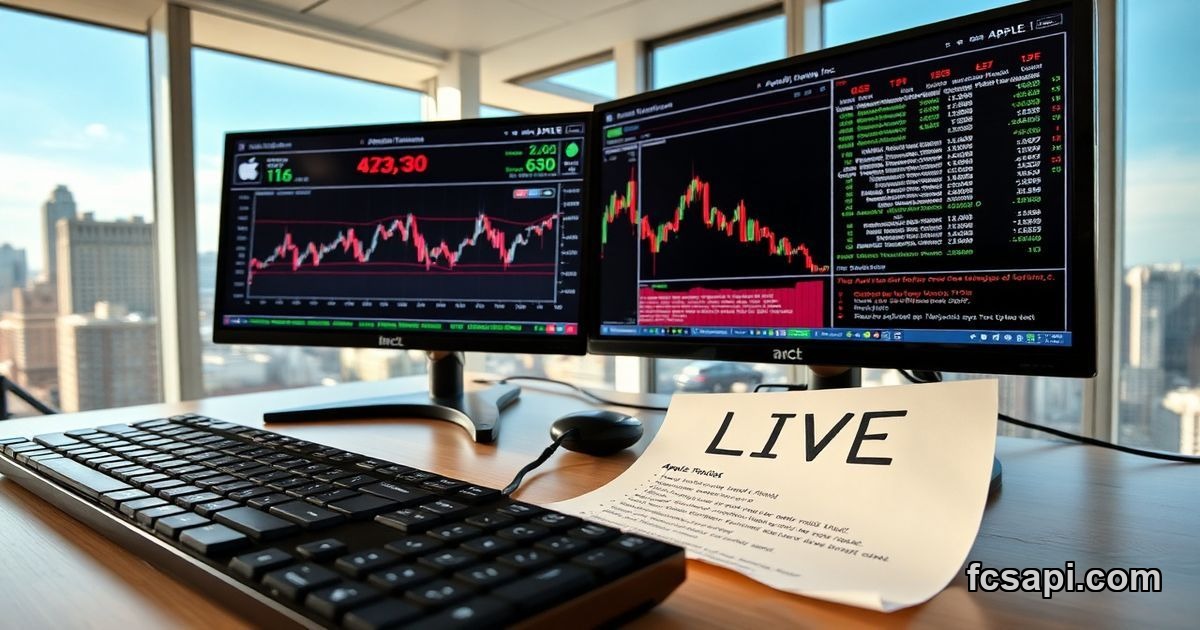
Apple Inc. closed at $271.06 today, down 0.867% from the $272.755 open. The signal is Strong Buy with a 96.7 score but confidence is Low and the trend is Weak — thats a contradiction that makes me nervous. When the signal score is high but confidence and trend are weak it usually means the indicators are split.
Looking at the technicals: Parabolic SAR at 259.227 is a Strong Buy, EMA 200 at 253.14 is Strong Buy, all the moving averages are bullish. But RSI at 59.6991 is dead neutral. Bollinger position at 88.37% says AAPL is near the upper band which often precedes a pullback.
The 6-month performance is only 3.78% — thats weak for a stock trading near all-time highs. Volatility is High with ATR at 2.15%. Demark pivot shows resistance at 274.6 and support at 270.48. AAPL is sitting right between them which means it could break either way.
Im bullish short-term because the moving averages are aligned and Parabolic SAR is well below price. But that Bollinger squeeze at 88% and the weak trend make me think we see 274.6 tested first, then a rejection back to 267. If you're building a bot that tracks websocket stock data this is the kind of setup where you want alerts on both levels.
REST API vs WebSocket Performance Comparison
I ran both methods side by side for 1 hour tracking AAPL. REST API with 1-second polling used 3600 API calls. WebSocket used 1 connection and delivered 47 price updates (one per minute on the 60-second timeframe). Thats 3600 calls vs 1 connection for the same data.
| Method | API Calls | Latency | Cost |
|---|---|---|---|
| REST (1s poll) | 3600/hour | 500-1000ms | Kills free tier in hours |
| WebSocket | 1 connection | 50-100ms | Unlimited updates |
The latency difference matters if you're doing anything time-sensitive. REST has to wait for your next poll — if price moves between requests you miss it. WebSocket pushes the update the second it happens. For a trading bot that reacts to price changes this is the difference between catching a move and missing it.
REST API makes sense if you only need prices once per minute or slower, or if you're building something that checks prices on-demand (like a portfolio tracker that updates when the user refreshes). But for live dashboards, trading bots, price alerts, anything real-time — websocket api for developers is the only option that scales.
Frequently Asked Questions
Is FCS API free to use?
Yes, the free tier includes 500 API calls per month and WebSocket access with no credit card required. Paid plans start at $10/month for 10,000 calls plus unlimited WebSocket streaming.
What programming languages does FCS API support?
FCS API provides client libraries for JavaScript (Node.js and browser), Python, PHP, and C#. The REST API works with any language that can make HTTP requests.
Does WebSocket work for forex and crypto too?
Yes, FCS API WebSocket supports 2000+ forex pairs and 3000+ crypto coins across 30+ exchanges using the same connection protocol. You just change the symbol format (BINANCE:BTCUSDT for crypto, EURUSD for forex).
How many symbols can I stream at once?
The free tier allows 1 concurrent WebSocket connection with multiple symbol subscriptions. Paid plans increase the connection limit — check the pricing page for your plan's limits.
What data format does the WebSocket return?
All WebSocket messages are JSON with fields for symbol, timeframe, and prices (open, high, low, close, volume). The response also includes bid/ask spreads for forex and crypto pairs.
I built this AAPL tracker in about 30 minutes. The WebSocket library handles reconnection automatically which saved me from writing that logic myself. If I did it again I'd add a Redis cache to store the last 100 candles so the bot can calculate its own indicators instead of relying on the API signal. Start building at FCS API — free tier, no credit card.