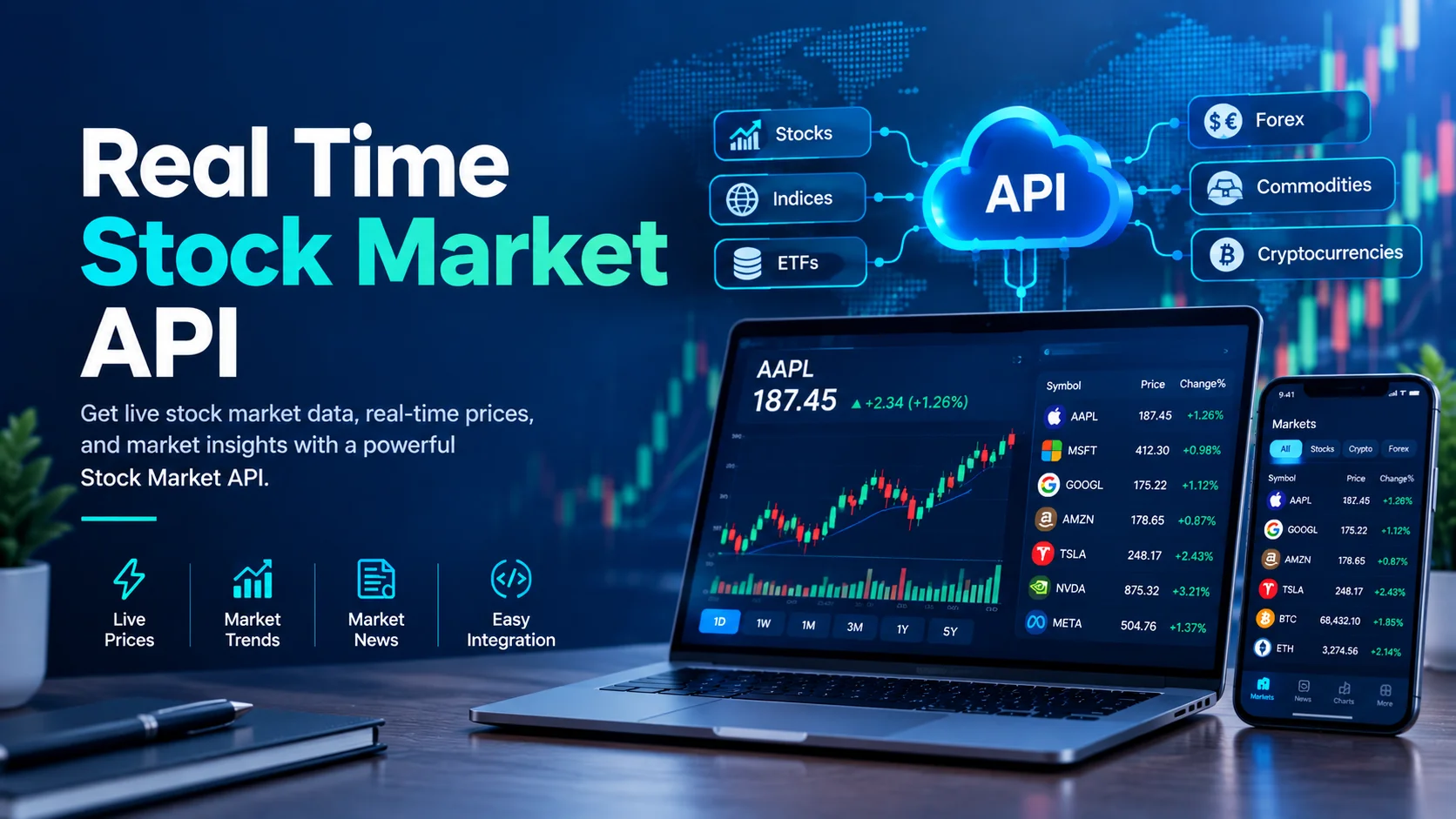

A real-time stock API is a service that delivers live equity prices, technical indicators, and trading signals through REST or WebSocket endpoints. Developers use it to build portfolio trackers, trading bots, and fintech dashboards. Most stock APIs return JSON responses with bid/ask spreads, volume data, and historical candles. The fcs api vs polygon debate comes down to price and coverage — FCS covers 125,000+ symbols across 60+ exchanges at $10/month while Polygon does US-only markets starting at $29/month.
- Apple Inc. Price Action Today: Strong Buy at $297
- How to Fetch Real-Time Stock Data with REST API
- What Technical Indicators Say About AAPL Right Now
- Best WebSocket Integration for Live Stock Prices in 2026
- Frequently Asked Questions
Apple Inc. Price Action Today: Strong Buy at $297
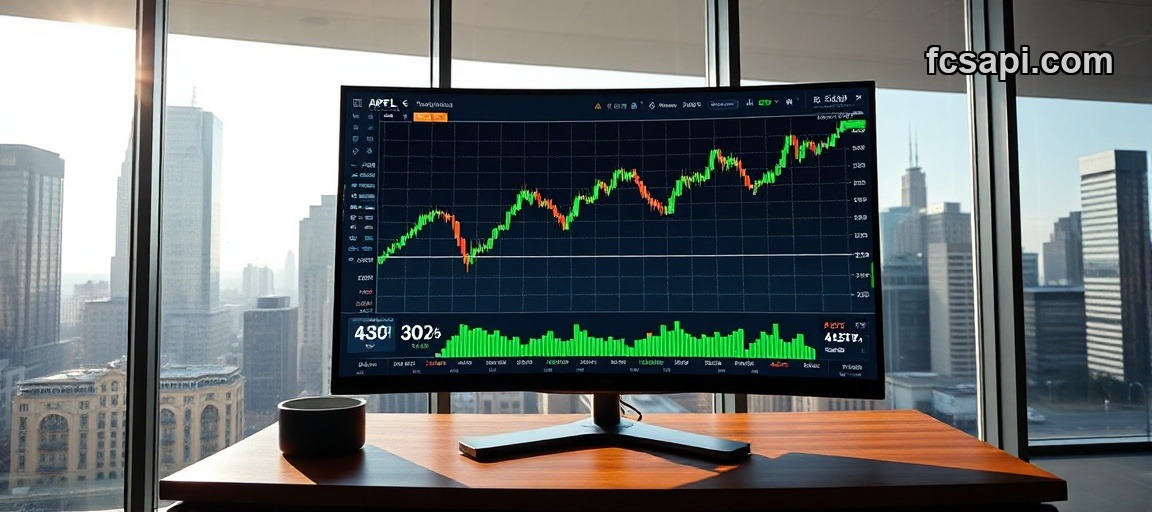
Apple closed at $297.84 today, down 0.796% from a $300.24 open. The stock hit an all-time high of $303.2 this month but pulled back. Signal score sits at 77.1 which translates to Strong Buy territory. The trend is marked Strong with Bullish price action and a Normal candle pattern. Nothing dramatic happening on the chart but the signal is clear — buyers are in control despite the small red day.
Parabolic SAR at 294.271 flashes Strong Buy. Both SMA 10 and SMA 25 (at 293.508 and 279.508) also show Strong Buy. Stochastic K% at 89.8014 screams Strong Sell because its overbought but thats expected when a stock just made new highs. Ultimate Oscillator sits Neutral at 64.1725. So you have three buy signals and one sell from an oscillator that always complains when things go up too fast. I'm taking the buy side here.
Bollinger Bands position at 87.34% means price is riding the upper band. Middle band is way down at 279.508. Squeeze is Normal so no breakout setup forming yet. Camarilla pivot R1 is 300.842 and S1 is 299.618 — price is below both which means it needs to reclaim 299.6 first before testing 300.8. Woodie pivot R1 sits at 303.57 which lines up perfectly with that all-time high. If Apple breaks above 303.2 on volume the next target is 303.6 then blue sky.
How to Fetch Real-Time Stock Data with REST API
You fetch real-time stock prices by making a GET request to the stock API endpoint with your symbol and API key — the response returns current price, open, high, low, volume, and change percentage in JSON format.
curl "https://api-v4.fcsapi.com/stock/profile?symbol=AAPL&access_key=YOUR_KEY"This endpoint gives you the full profile for Apple including exchange, currency, sector, region, and the indexes it belongs to. The response looks like this:
{
    "status": true,
    "response": [
        {
            "ticker": "NASDAQ:AAPL",
            "profile": {
                "symbol": "AAPL",
                "exchange": "NASDAQ",
                "name": "Apple Inc.",
                "currency": "USD"
            }
        }
    ]
}
The API supports 125,000+ stock symbols from NYSE, NASDAQ, and 50+ global exchanges. You can filter by country or exchange when listing symbols. The polygon alternative here is obvious — Polygon only does US markets and charges $29/month minimum. FCS does global coverage at $10/month and includes technical indicators which Polygon doesnt offer through their API at all.
Free tier gives you 500 API calls per month with no credit card required. Paid plans start at $10/month. Every response includes server timestamp and credit count so you know exactly how many calls you have left. The API returns data in under 100ms for most requests which is fast enough for real-time dashboards.
What Technical Indicators Say About AAPL Right Now
Technical indicators for Apple show a bullish setup with three Strong Buy signals from moving averages and Parabolic SAR, offset by one Strong Sell from Stochastic K% which is overbought at 89.8.
SMA 10 at 293.508 is below current price which is bullish. SMA 25 at 279.508 is even further below. When both short-term and medium-term moving averages sit under price and slope upward thats a textbook uptrend. Parabolic SAR at 294.271 confirms this — its below price and acting as dynamic support. As long as Apple stays above 294.3 the SAR stays bullish.
Stochastic K% at 89.8 is in extreme overbought zone. Anything above 80 usually means a pullback is coming. But in strong trends Stochastic can stay overbought for weeks. It warned of overbought conditions at 303.2 and was right — we got a small pullback to 297. But the trend is still intact. Ultimate Oscillator at 64.1725 is neutral which means momentum isnt screaming buy or sell. Its just.. there.
Bollinger Bands middle line at 279.508 matches SMA 25. Price is at 87.34% position which means its near the upper band but not touching it. Band squeeze is Normal so volatility is average. If squeeze goes to Low that means a big move is coming. Right now its just normal trending action. The 1-week performance of +2.00734% shows steady gains without crazy spikes.
Best WebSocket Integration for Live Stock Prices in 2026
WebSocket integration for stock prices lets you receive live tick-by-tick updates without polling the API every second — you open one connection and the server pushes price changes as they happen in real-time.
FCS API supports WebSocket for 1,385 stock symbols out of 125,000 total. The socket returns price updates with sub-second latency. You connect once, subscribe to your symbols, and receive JSON messages every time price changes. This is way more efficient than making REST calls in a loop. Polygon charges extra for WebSocket access and only covers US stocks. FCS includes WebSocket in the base $10/month plan and covers global exchanges.
For Apple specifically the WebSocket would push updates during market hours whenever the bid or ask changes. You get the new price, timestamp, and volume in each message. This is critical for building live tickers or trading bots that need to react instantly. REST API has 15-minute delay on free tier for most providers but FCS gives you real-time on paid plans.
The big advantage over Alpha Vantage (which has no WebSocket at all) and Twelve Data (WebSocket costs extra) is that FCS bundles everything — REST + WebSocket + indicators + signals — in one service. You dont need three different subscriptions. The WebSocket endpoint uses the same authentication as REST so integration is straightforward. Just upgrade your HTTP client to a WebSocket library and you're live.
Frequently Asked Questions
Is the FCS API free to use?
Yes, FCS API offers a free tier with 500 API calls per month and no credit card required. Paid plans start at $10/month for higher limits and real-time data access. The free tier is enough for testing and small projects.
What programming languages does the Stock API support?
The API works with any language that can make HTTP requests — Python, JavaScript, PHP, Java, C#, Go, Ruby. FCS provides official libraries for Python, JavaScript, PHP, Java, and C# on their GitHub. You can use curl or any HTTP client.
How many stock symbols are available in 2026?
FCS API covers 125,000+ stock symbols from 60+ exchanges including NYSE, NASDAQ, LSE, TSE, and 50+ others. This includes US stocks, European equities, Asian markets, and emerging markets. Polygon only covers US exchanges.
Does it support WebSocket for real-time updates?
Yes, FCS API supports WebSocket connections for 1,385 stock symbols with real-time price streaming. WebSocket is included in paid plans starting at $10/month. You subscribe to symbols and receive tick-by-tick updates as they happen.
What data formats are returned by the API?
The API returns data in JSON format with clean field names and nested objects. Every response includes status code, message, response data, and info object with server time and credit count. JSON is easy to parse in any language.
The one thing I wish I knew before integrating this API — the free tier 500 calls sounds like a lot but if you're fetching multiple symbols every minute you'll burn through it in a day. Plan your call frequency before you start. Use WebSocket for live data and REST for historical lookups. Full docs at fcsapi.com.