


March 14, 2026. NVIDIA Corporation (NVDA) just closed down at 180.25, a -2.525% dip from its open of 184.92. This isn't just a slight bump; it’s a pretty notable drop, and the system threw out a solid "Sell" signal with a -39.6 score. You'd think that would make things clear, right?
Funny thing about clear signals though, they rarely stay that way. Even with that chunky percentage change today, calling this a straightforward move is just asking for trouble. The underlying mechanics are fighting each other like cats in a sack, and if you aren't paying attention, you're going to lose some fur.
The Signal Speaks, But What Does It Really Say?
Our system flagged NVIDIA Corporation (NVDA) with a clear "Sell" signal today, and it wasn't a weak whisper. The Signal Score of -39.6, backed by "Medium" confidence, sounds pretty convincing on paper. But then you look a little closer at the details from the FCS API, and things get.. weird.
Hold on a second, because right there, next to "Signal: Sell," it also tells us "Price Action: Bullish." Yeah, you read that right. A sell signal, but bullish price action. Someone's definitely got a screw loose somewhere, and it's probably my broker if I just followed the initial signal without checking.
Then there’s the ATR, the Average True Range, which is supposed to tell you something about volatility and potential movement. It’s sitting at 5.9685, and guess what? That particular oscillator is flashing a "Buy" signal. So, we've got a Sell, a Bullish Price Action, and a Buy. If that's not a recipe for confusion, I don't know what is.
The Unambiguous Drag of the Averages
While the front-page signal might be having an identity crisis, some things just don't lie. Moving Averages, for example. These are the workhorses, and right now, they’re painting a pretty grim picture for NVIDIA Corporation. There’s no ambiguity here, not a shred.
The 100-day Exponential Moving Average, the EMA 100, is at 182.896, screaming "Strong Sell." The Simple Moving Average, SMA 100, is even higher at 185.87, also blaring "Strong Sell." These aren't just minor dips; these are pretty strong indications that, structurally, this stock is under pressure.
When both the short-term responsiveness of the EMA and the longer-term trend of the SMA point directly to the exit, you'd be foolish to ignore it. Those lines tell a story of selling pressure building up over time. It's a weight that’s hard to shrug off, even for a growth giant like NVDA.
Oscillators: A Muddled Picture of Mixed Signals
Okay, so the moving averages are pretty clear, but let's go back to those oscillators. They’re usually good for finding momentum shifts, but today they just amplify the mess. The Ultimate Oscillator is parked right in the middle at 50.4036, which means it’s just plain "Neutral." No conviction there, absolutely none.
But then you glance at the MACD Level, a crucial momentum indicator, and it’s at -1.0046, which is flagged as a "Strong Sell." See? Even within the same category of tools, the indicators are completely at odds. It's like asking three different doctors for a diagnosis and getting three wildly different answers.
What are you supposed to do with a situation like this? One says to sell with conviction, another says to buy, and the third just shrugs. It's not just a puzzle; it's a dangerous minefield where every step could be the wrong one. You rely on data to make decisions, and when the data can’t make up its mind, that's a problem.
The Immediate Price Picture and Volatility's Grip
Let's talk about the cold hard cash price of 180.25 today. The stock opened higher, remember, at 184.92, only to drift down over the session. If you look at the Fibonacci pivot points, the primary pivot (P) for the day was 183.277. The first support (S1) sits at 182.058.
NVIDIA Corporation dropped straight through both of those. That's not just a bad look; it suggests the bears had control, at least in the intraday session. Losing those support levels, especially S1, makes the path ahead look a lot less sturdy. You don't want to see prices below your initial support levels. 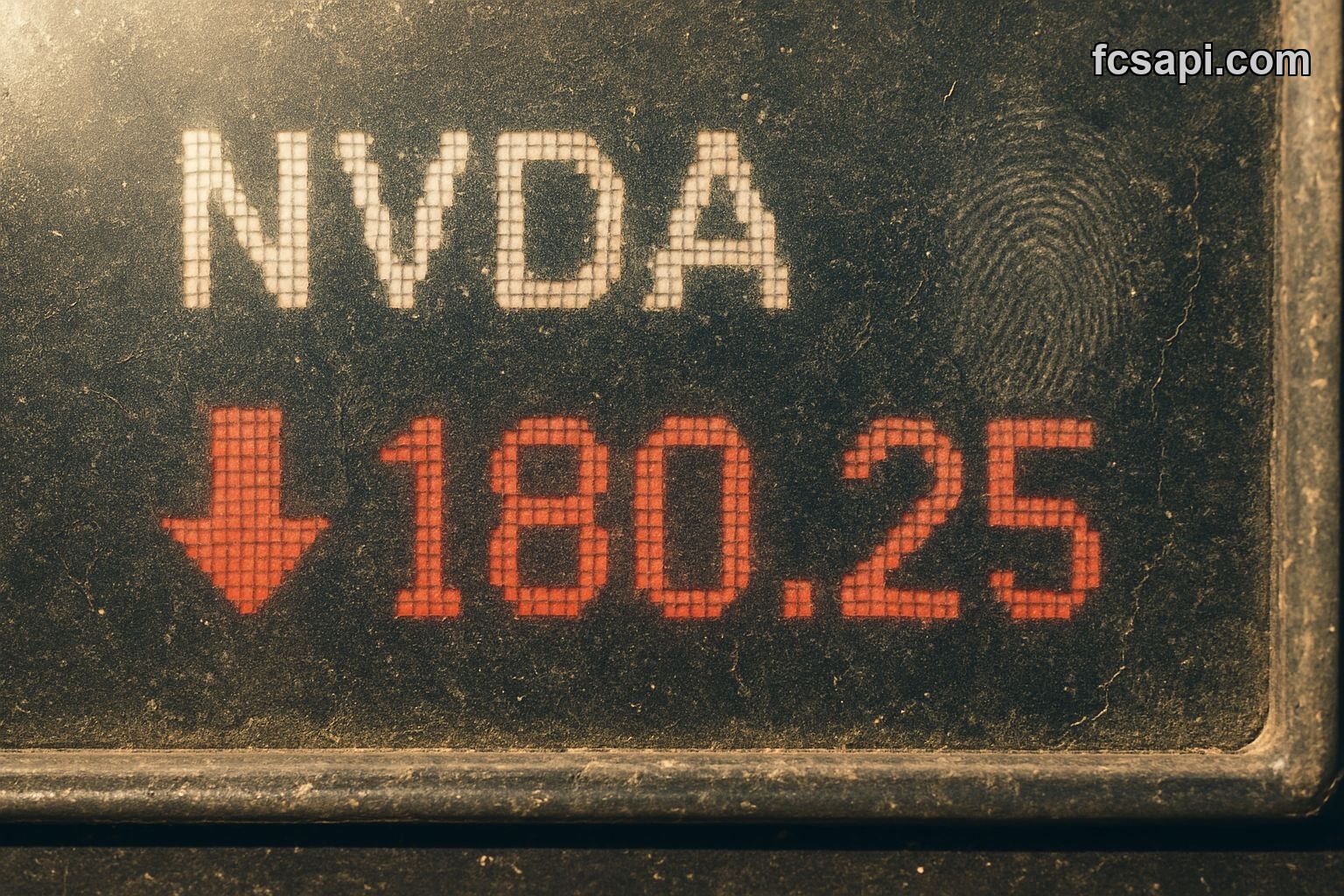
Adding another layer to this chaotic picture is the Volatility. It’s rated as "High," with an ATR% of 3.259. That's not some sleepy dividend stock. This thing moves, and when the signals are contradictory, high volatility means whatever move it makes, it'll make it fast and hard. You can get whipsawed in this environment quicker than you can say "margin call."
Performance History and The Unseen Risk
NVIDIA Corporation has had quite a ride, hitting an All-Time High of 212.19 and an All-Time Low way back at 0.0333335. This isn't a company new to big swings or drastic changes. The current price of 180.25 might seem relatively calm when you put it against its wild history, but that's precisely the trap.
The "Moderate" trend signal is also a tricky one. Moderate can mean steady, but in combination with high volatility and conflicting indicators, it could also mean "lulling you into a false sense of security." When everything is yelling conflicting directions, the risk isn't just about picking the wrong path; it's about the erosion of capital while you try to figure out which path is the wrong one.
Reliable data is everything in these conditions. The raw numbers from a service like FCS API give you the components to form your own conviction. Without them, you’re just guessing. You can even see the various types of information provided directly in the stock API documentation, which helps understand where all these conflicting indicators actually come from. You can also explore different API pricing plans to see what suits your needs for real-time market insights.
Why Risk is the Only Constant Today for NVDA
So, what does this all boil down to for NVIDIA Corporation price today? A big, fat question mark, but with the specific flavor of "potential downside." You’ve got a system-generated "Sell" against "Bullish Price Action." You've got "Strong Sell" moving averages battling a "Buy" from the ATR. The MACD is bearish while the Ultimate Oscillator is taking a nap.
This isn't an "it depends" situation; it's a "you're likely going to get burned if you jump in blindly" situation. The high volatility means a decision based on any single one of these conflicting signals could be catastrophically wrong, and fast. The only clear consensus here is that there is no consensus. More analysis on market dynamics and individual stocks can often be found on the FCS API blog.
This kind of uncertainty is where serious losses happen, not in clear up or down trends. When the market is this indecisive, it usually means it’s just waiting for a catalyst to pick a very aggressive direction, and that direction isn't always obvious until it’s too late. An NVIDIA Corporation prediction right now means acknowledging the sheer risk.
What I’d Do
Frankly, with this kind of mixed bag from NVIDIA Corporation, I’d be on the sidelines. There are too many conflicting signals, too much volatility, and not enough conviction to justify putting capital at risk today, March 14, 2026.